Every Signal, No Filter
This is the simplest possible test of a signal tool: take every alert it gives, for the same stake and the same trade time, and count what happens. The tool is the PipGems Advance Signal on Quotex. The trader used a demo account, $50 per trade, 1-minute trades, and regular market pairs only — no OTC.
We went through the video frame by frame and checked each trade against the trade history and the account balance: 12 trades, 8 wins, 3 losses, 1 tie, +$179. The balance moved from $16,003.30 to $16,182.30, which is exactly that total.
The more interesting finding is in the Signal checks panel. Every alert came with a grade, and in this session the grade pointed the wrong way.
What You See When an Alert Fires
- The signal banner — pair, direction and a countdown, for example EURGBP ▲ CALL 57s.
- Signal checks — how this pair's signals did at the real entry price over the last hour (Hist 1h) and three hours (Hist 3h), boiled down to a grade such as Low or Fair. Below it, a gauge of how many indicators agree right now on each timeframe.
- Pair Filter — the pairs you want alerts for. Seven were switched on at the start (EUR/USD, USD/JPY, AUD/USD, EUR/JPY, AUD/JPY, CAD/JPY and EUR/GBP), six later on.
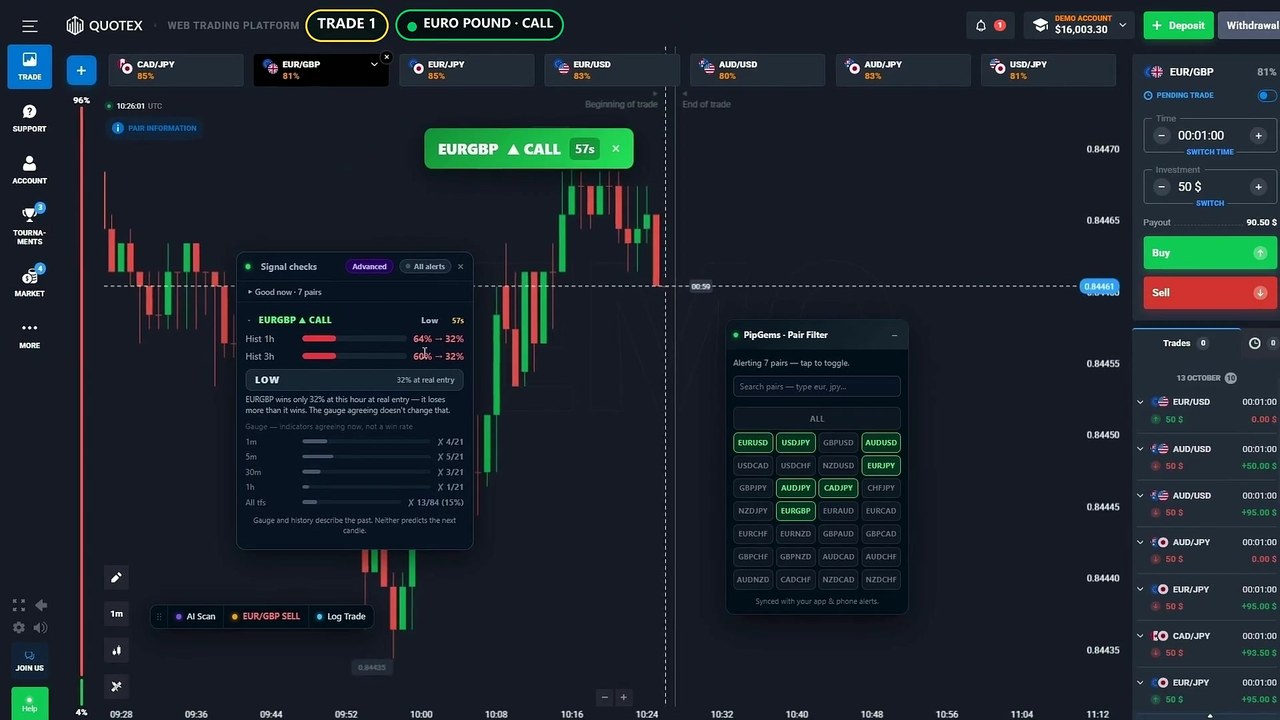
The first trade shows all three. The banner says EUR/GBP CALL. Signal checks grades it Low: “EURGBP wins only 32% at this hour at real entry — it loses more than it wins.” The trader took it anyway, as the test requires, and it won ($90.50 back on $50).
All 12 Trades
| # | Pair | Signal | Grade (hist. at entry) | Payout | Result | P/L |
|---|---|---|---|---|---|---|
| 1 | EUR/GBP | CALL | Low (32%) | 81% | Win | +$40.50 |
| 2 | AUD/USD | CALL | Low (37%) | 80% | Win | +$40.00 |
| 3 | EUR/USD | PUT | Low (47%) | — | Loss | −$50.00 |
| 4 | USD/JPY | CALL | Low (47%) | 81% | Win | +$40.50 |
| 5 | CAD/JPY | CALL | Fair (59%) | — | Loss | −$50.00 |
| 6 | AUD/USD | CALL | Low (37%) | 80% | Win | +$40.00 |
| 7 | EUR/JPY | CALL | Fair (59%) | — | Loss | −$50.00 |
| 8 | EUR/USD | CALL | Low (47%) | 85% | Win | +$42.50 |
| 9 | EUR/JPY | PUT | Low (59%) | 88% | Win | +$44.00 |
| 10 | EUR/USD | CALL | Low (47%) | 85% | Win | +$42.50 |
| 11 | USD/JPY | PUT | Low (47%) | — | Tie | $0.00 |
| 12 | AUD/USD | PUT | Low (37%) | 78% | Win | +$39.00 |
The payout is only shown for the trades where it was readable on screen; the three losses paid nothing either way. Trade 11 closed exactly at the entry price, so Quotex returned the $50 stake.
Total: 12 trades, 8 wins, 3 losses, 1 tie, +$179 on $600 staked. At an 80–85% payout you need to win roughly 54–56% of trades to break even.
The Grades Pointed the Wrong Way
Ten of the twelve alerts were graded Low and two were graded Fair. You would expect the Fair ones to do better. They did not:
Both Fair signals were calls on a yen pair. CAD/JPY (trade 5) had the best history on screen — 75% over the last hour — and lost. EUR/JPY (trade 7) showed 65% and lost too.
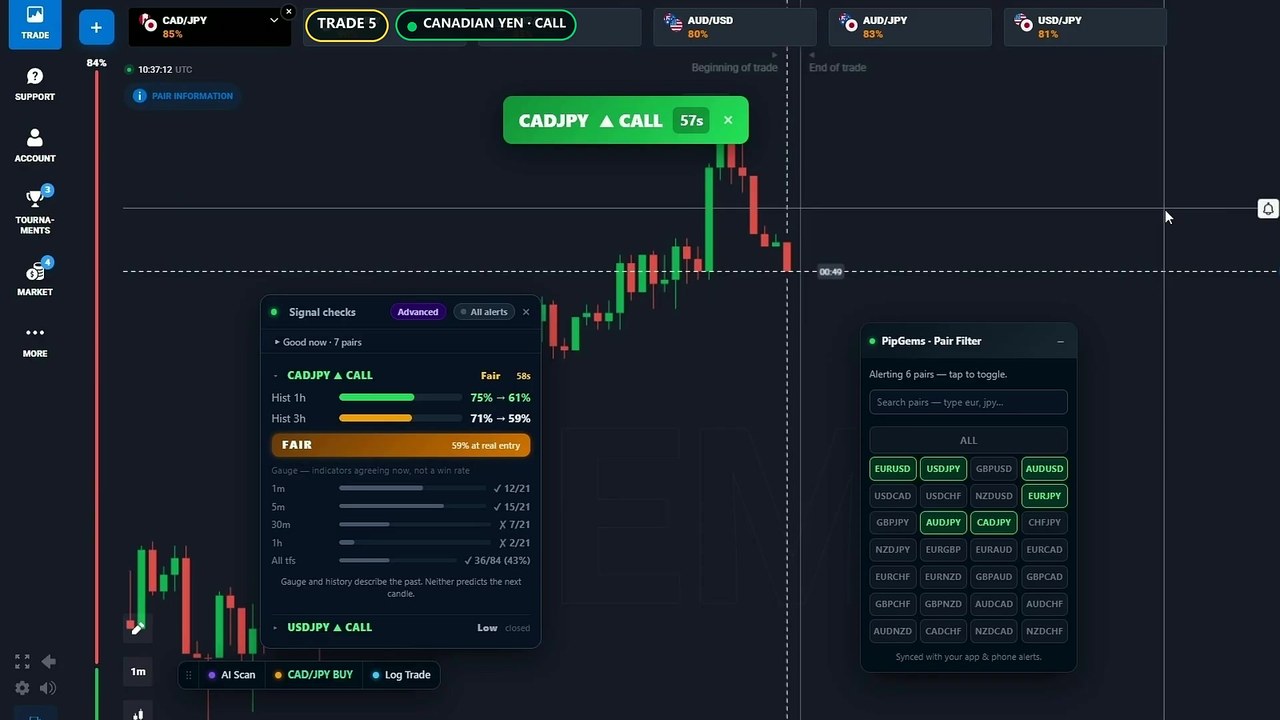
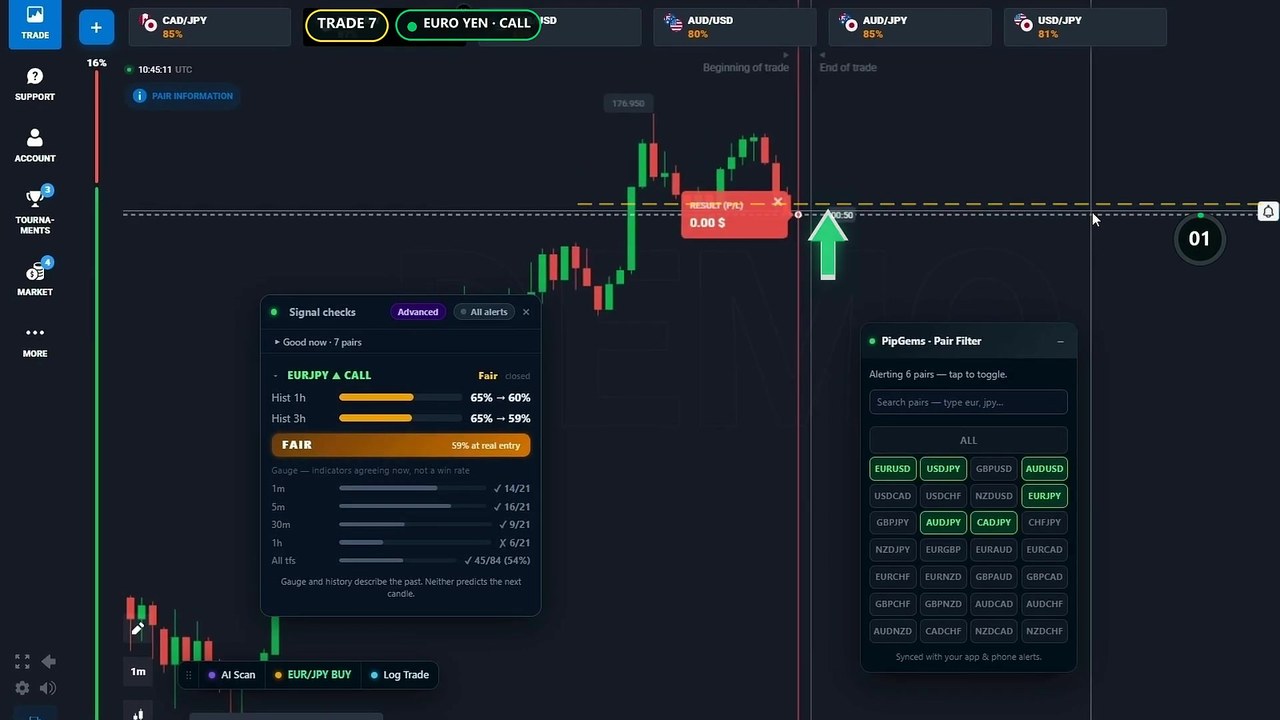
This does not mean Low signals are better. Twelve trades is nowhere near enough to rank grades, and the panel itself says it plainly: “Gauge and history describe the past. Neither predicts the next candle.” What the session does show is that the grade is not a filter you can lean on blindly. If you had skipped every Low signal, you would have skipped all eight winners.
Two Signals at Once
At trade 9 the tool sent an EUR/JPY PUT, and while that trade was still running an EUR/USD CALL arrived. The trader took both at the same $50 stake. Both won: $94 back on EUR/JPY and $92.50 on EUR/USD.
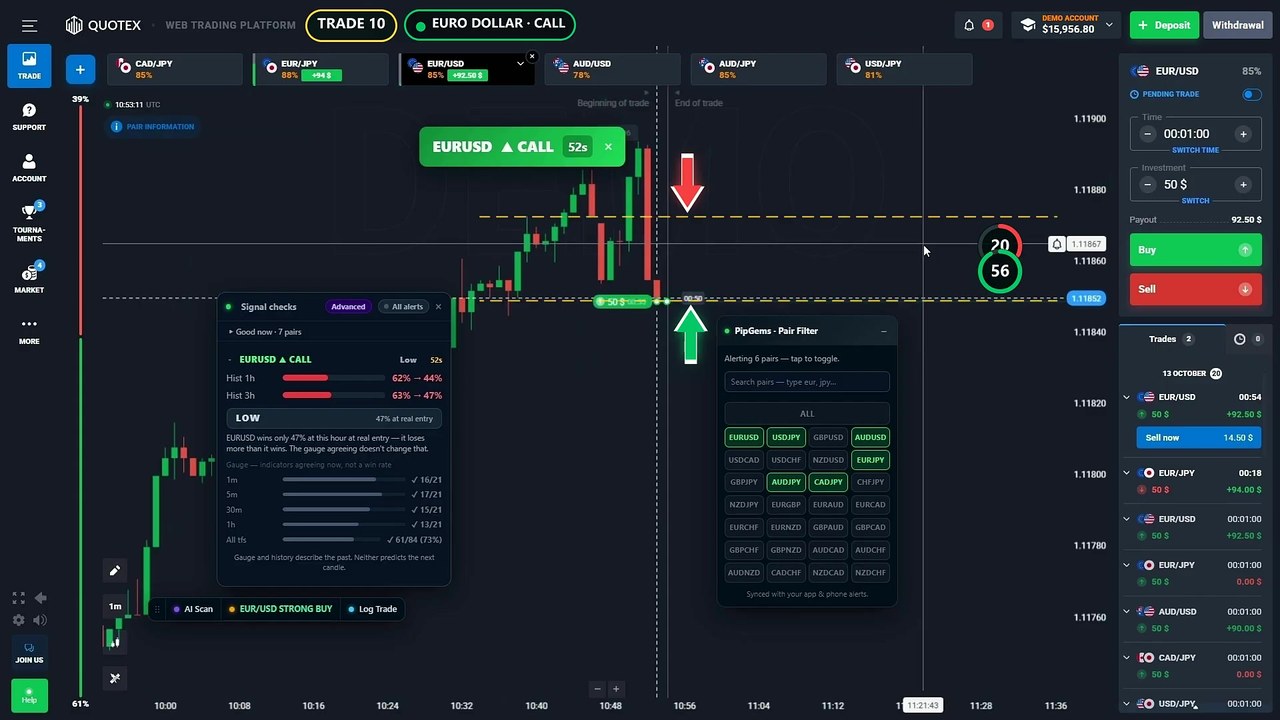
It worked here, but two open trades doubles the money at risk at the same moment. If you follow every alert, decide in advance whether you allow overlapping trades, and stick to it.
Regular Pairs Only
Every trade was on a regular market pair — EUR/GBP, AUD/USD, EUR/USD, USD/JPY, CAD/JPY and EUR/JPY — during the London session. None were OTC. OTC prices come from the broker's own feed rather than the interbank market, so this session tells you nothing about OTC pairs.
Watch the Video
All twelve trades from entry to result, including the three losses and the tie:
Honest Weaknesses
- Twelve trades on one morning. A good session or a bad one can come from luck alone at this size.
- Demo account. Entries were taken at the alert price; on a real account a second or two of delay can move the entry on 1-minute trades.
- The grade did not help. If you were planning to use Low/Fair as your filter, this session is a reason to test that first.
- Overlapping trades. Trades 9 and 10 ran at the same time, which a strict one-trade-at-a-time plan would not allow.
How to Test It Yourself
- Set the Pair Filter first and keep the same pairs for the whole test.
- Take every alert for 1 minute at one flat stake — no picking and choosing.
- Write down the grade next to each result. After 50 trades you will know whether Low and Fair mean anything for your pairs and your hours.
- Compare your win rate with the break-even for your payout before risking real money.
Risk Management
- One stake for the whole session — no doubling after a loss.
- Set a daily loss limit and a maximum number of trades, and stop at either.
- Know your break-even: about 54% at an 85% payout, about 56% at 80%.
- Practise on a demo account first, and never trade money you cannot afford to lose.
Frequently Asked Questions
What is the PipGems Advance Signal?
An alert from the PipGems extension that shows the pair, the direction (CALL or PUT) and a countdown in a banner on your Quotex chart. In this video every alert was traded for 1 minute at the moment it appeared.
What do Low and Fair mean in Signal checks?
They grade how that pair's signals have done during the last hour and three hours at the real entry price. Low means the pair has been losing more than it wins this hour; Fair means it has been winning a little more often. The panel itself says that history describes the past and does not predict the next candle.
Did the Fair signals do better than the Low ones?
Not in this session. Both Fair signals lost, while the ten Low signals produced eight wins, one loss and one tie. Twelve trades is far too few to say the grade works backwards, only that it did not help here.
What was the result in the video?
12 trades at $50 each on a Quotex demo account: 8 wins, 3 losses and 1 tie, for +$179. The balance went from $16,003.30 to $16,182.30, which matches the trade-by-trade total.
The Verdict
4 out of 5. A clean, honest test: every alert taken, one flat stake, regular pairs, and every result shown — including the losses and a tie — with a balance that adds up to the cent.
The missing star: twelve trades on a demo account is a demonstration, not proof, and the Signal checks grades did not line up with the results. Treat the alerts as a starting point, and let your own logged sample decide which ones to keep.
#Quotex #PipGems #TradingSignals #1MinuteTrading #BinaryOptions #TradingStrategy
This content is for educational purposes only and is not financial advice. Trading involves substantial risk; you can lose some or all of your capital. No result is guaranteed and past results do not indicate future outcomes. Always practise responsible money management, limit your daily trades, and trade only what you can afford to lose.
Related reading: PipGems signals traded as 1-minute reversals on Quotex, what the PipGems signal grades are worth, and low-history alerts on Pocket Option. For more, see the Quotex hub and the strategy library.