A Signal Plus a Stretched Chart
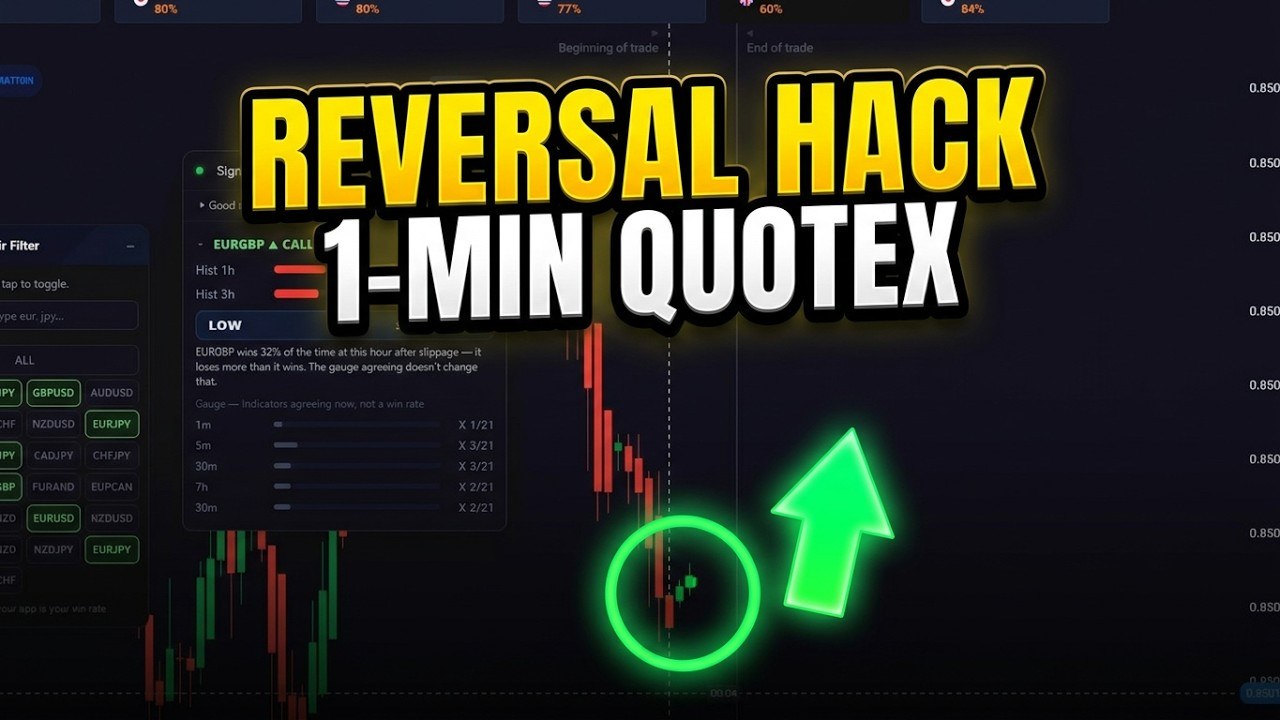
This session pairs two things. The first is a live signal from PipGems, shown in its Signal checks window on top of the Quotex chart. The second is the chart itself: the trader only takes a signal when price has just made a fast move against it. A CALL after a sharp drop, a PUT after a quick rally. The signal gives the direction and the stretched move gives the timing.
Everything runs on a Quotex live account with a flat $20 stake and a 1-minute expiry, on regular forex pairs only, no OTC. The session was recorded on 2 October between about 17:54 and 18:13 UTC. We read every trade off the Quotex history panel, checked each balance step, and compared it with the narration and the video’s own result card.
The Setup
- Pair filter: six pairs alerting: EUR/USD, USD/JPY, GBP/USD, EUR/JPY, AUD/JPY and EUR/GBP. You type a pair name in the filter and tap it to add it.
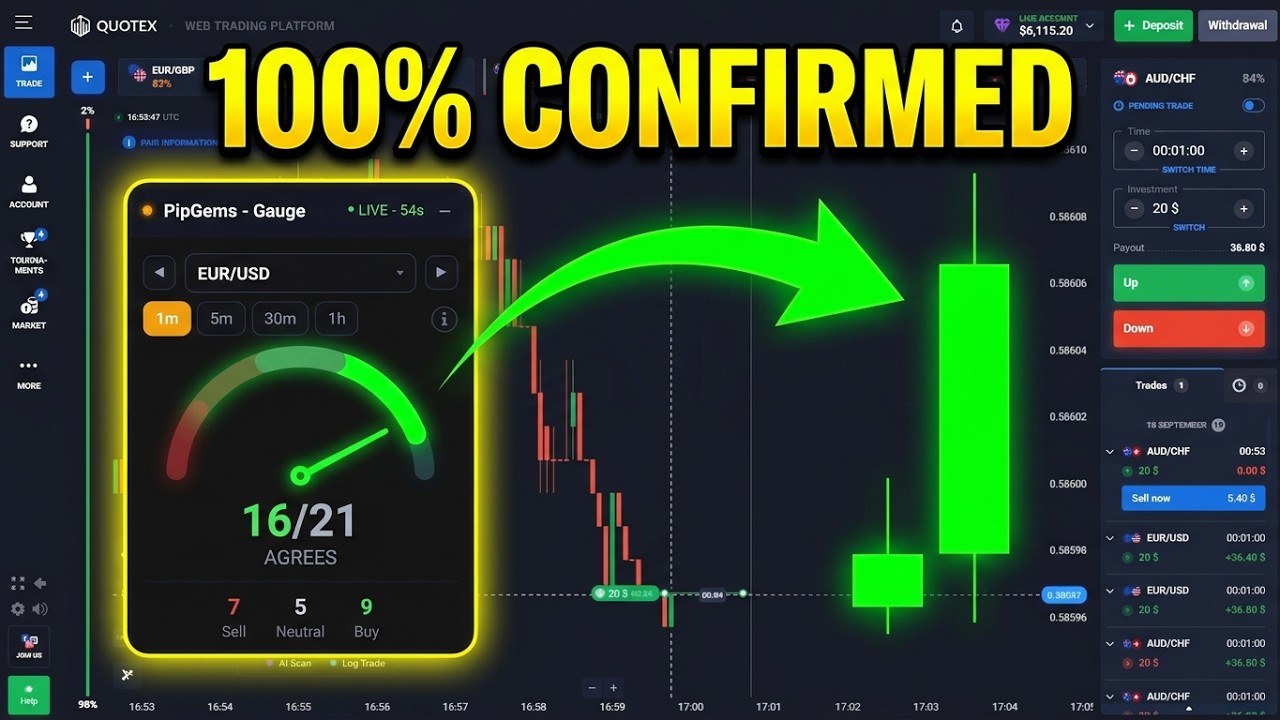
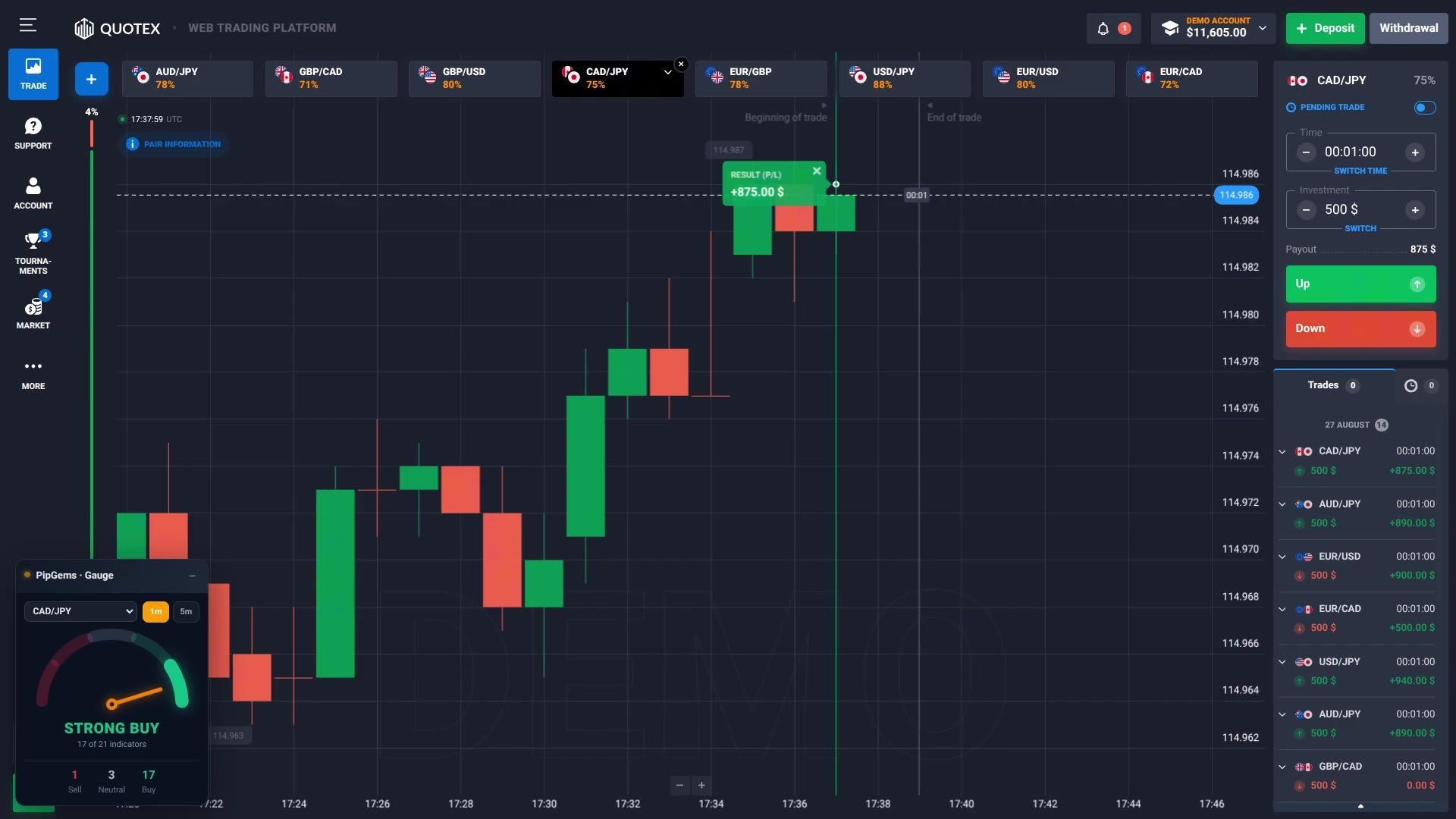
- Signal checks window: lists the pairs with a live buy or sell signal. Each one shows its 1-hour and 3-hour history at this time of day, a grade (Low, Fair or better) after slippage, and the gauge, which counts how many of 21 indicators agree on each timeframe.
- Alert filter: set to All alerts. It started on Good+ only, and the first signal of the session made no sound because it was graded Fair.
- Quotex chart: 10-second candles, 1-minute trades, $20 per trade, no doubling.
The Entry Rule
The narration states it trade by trade: “The price has fallen sharply, so we’re going up on this one,” and “The price has risen quickly, so we’re going down.” Put together:
- A PipGems signal arrives on a pair in your filter.
- Look at the last minute or two of candles. Is price in a fast move opposite to the signal?
- If yes, enter in the signal’s direction near the end of that move. CALL after a sharp drop, PUT after a fast rally.
- If price is drifting sideways, or already moving the signal’s way, wait for the next one. “We never force a trade.”
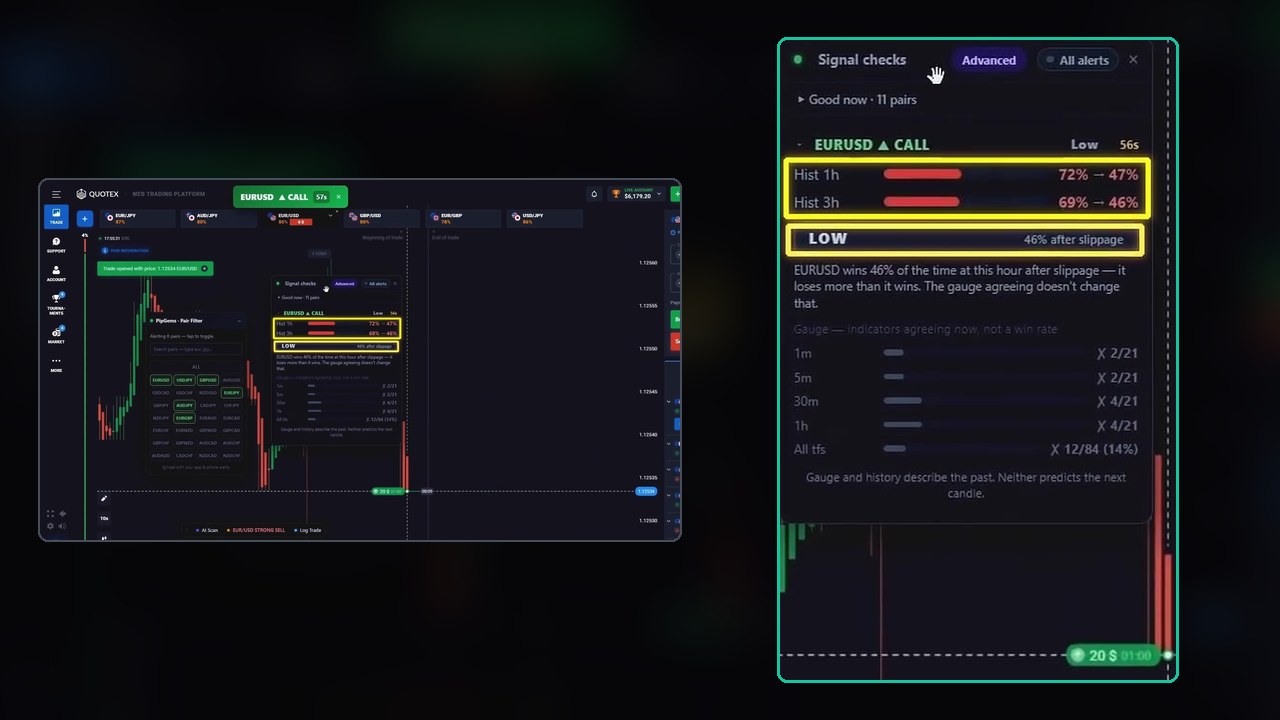
The EUR/USD trade shows how far this goes. The signal is a CALL graded Low, 46% after slippage. The gauge reads 12 of 84 indicators in agreement (14%), and the AI Scan chip at the bottom of the chart says EUR/USD STRONG SELL. The trader still buys at 1.12534, at the bottom of a hard drop, because the rule is about the stretch, not the grade. That one ended in a draw.
Every Trade, Checked
The balance before the first trade is $6,182.20. Each trade takes $20 off when it opens. A win pays back the stake plus the payout, and a draw returns the $20. The Quotex day counter goes from 21 to 32 trades during the video, so eleven trades were placed on camera.
| # | Pair | Signal (grade) | What the chart did first | Result |
|---|---|---|---|---|
| 1 | EUR/JPY | CALL Fair 62% | Drop into the entry | +$17.00 |
| 2 | EUR/USD | CALL Low 46% | Sharp fall | Draw, $0 |
| 3 | EUR/GBP | PUT Low 32% | Fast rally | −$20.00 |
| – | EUR/GBP | PUT manual, no signal | Same rally | Draw, $0 (not counted) |
| 4 | AUD/JPY | CALL Low 43% | Drop | +$16.00 |
| 5 | EUR/GBP | CALL Low 32% | Steep fall | +$12.00 |
| 6 | EUR/JPY | PUT Fair 62% | Bounce up | +$16.60 |
| 7 | AUD/JPY | CALL Low 43% | Slide lower | −$20.00 |
| 8 | AUD/JPY | CALL same signal | Still falling | +$16.00 |
| 9 | AUD/JPY | CALL same signal | Still falling | +$16.00 |
| 10 | GBP/USD | CALL Low 41% | Drop | Draw, $0 |
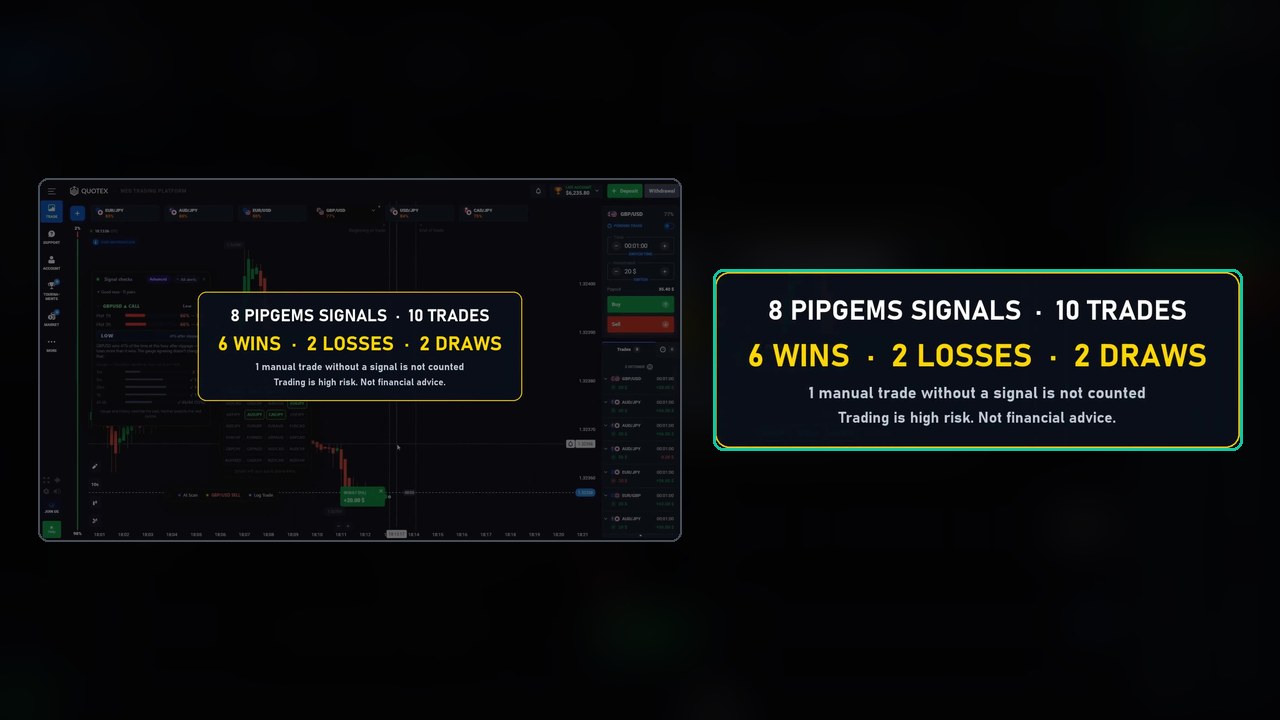
The numbers add up. Six wins come to +$93.60, two losses to −$40, and the three draws to nothing. That is +$53.60, and the balance on screen ends at $6,235.80, exactly $53.60 above where it started. The video’s result card says 8 signals, 10 trades, 6 wins, 2 losses, 2 draws. It leaves out the manual EUR/GBP sell, which the trader says on camera was not a PipGems signal. That trade was a draw, so leaving it out does not change the money.
The Payout Moved Mid-Session
Not every win paid the same. EUR/JPY paid 85% on the first trade and 83% later. AUD/JPY paid 80%. EUR/GBP was listed at 78% at the start, but by trade 5 the payout had dropped to 60%, so that win was only +$12. At 60% you need to win 62.5% of trades just to break even. Check the payout on the trade panel before every click, not once at the start.
Three Trades Worth a Closer Look
EUR/GBP Sell: Everything Agreed, and It Lost
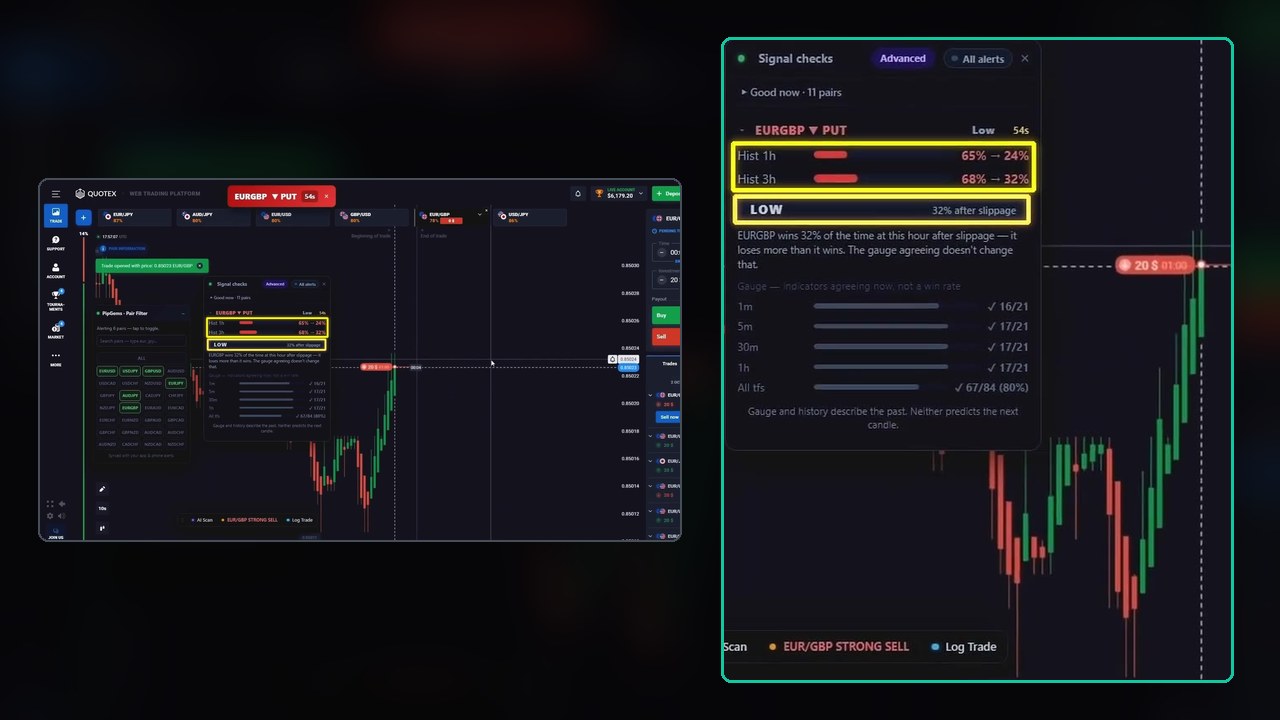
Trade 3 is the one where the indicators lined up best. The PUT came after a fast rally, and the gauge agreed strongly: 67 of 84 (80%), with 16 or 17 of 21 on every timeframe. But the grade was Low, 32%, and the trade lost. The panel’s own text explains why it lets the gauge sit next to a Low grade: “The gauge agreeing doesn’t change that.”
Trade 5 went the other way. The EUR/GBP CALL also had a Low grade (32%), and only 8 of 84 indicators agreed (10%). It won. In this session gauge agreement told you nothing about the outcome. Eleven trades is far too few to say more than that.
AUD/JPY: Three Buys on One Signal
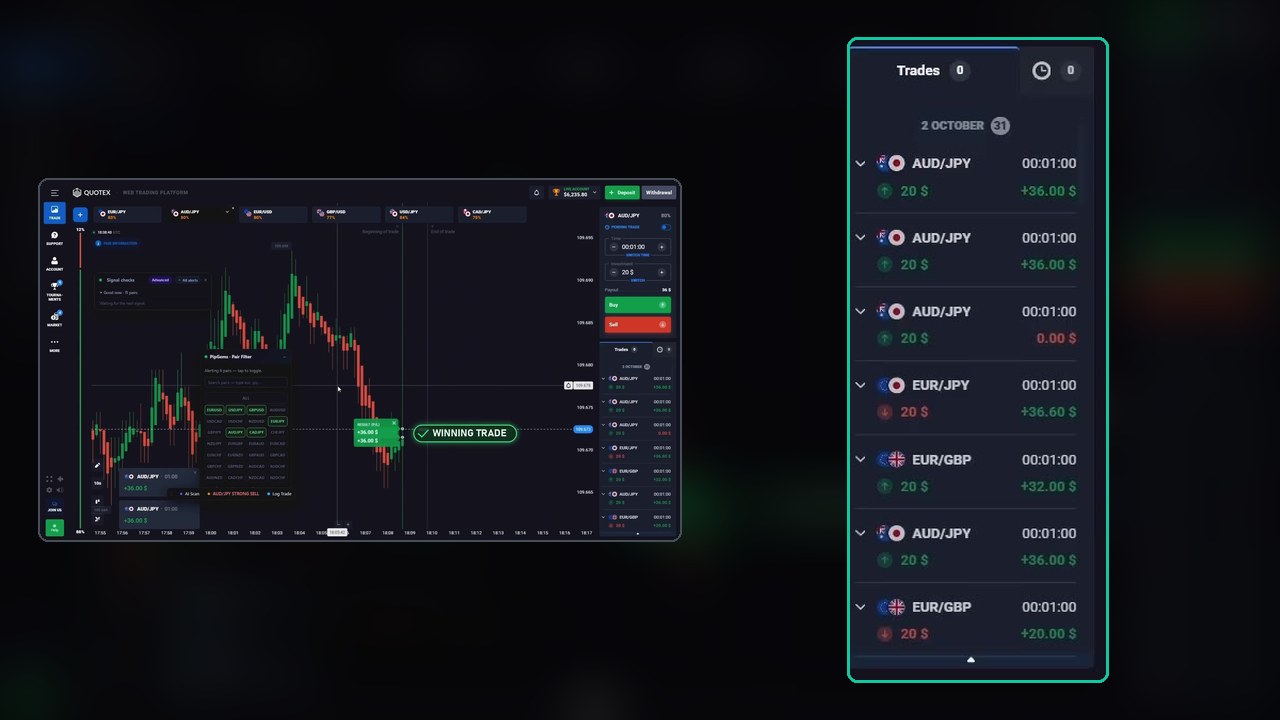
Near the end, the AUD/JPY CALL signal stayed up while price kept sliding. The first buy lost. The trader then bought twice more on the same signal, and both of those won (+$36 back on each). The stake stayed at $20, so this is not martingale. But adding entries to a signal that has just lost is still a way to double your exposure to one idea. The result was green here. If the slide had carried on, it would have been three losses instead of one.
The Fair Signal You Would Have Missed
The first trade, a EUR/JPY CALL, was graded Fair. The alert filter was on Good+ only, so it made no sound. The trader spotted it in the Signal checks window, took it, and switched the filter to All alerts. It won. Every signal in this video was Fair or Low. With the alerts left on Good+, the session would have been silent.
Video Chapters
- 0:00 Preview of the results
- 0:23 The Signal checks window
- 0:49 Pair filter: regular forex pairs only
- 1:14 EUR/JPY CALL, Fair: the alert that did not sound, won
- 1:40 EUR/USD CALL, Low, after a sharp fall: draw
- 2:20 EUR/GBP PUT, Low, after a fast rally: lost
- 2:55 Extra manual EUR/GBP sell (not counted): draw
- 3:12 AUD/JPY CALL, Low: won
- 3:48 EUR/GBP CALL, Low, gauge disagrees: won
- 4:28 EUR/JPY PUT, Fair, after a bounce: won
- 5:10 AUD/JPY CALL three times: one loss, two wins
- 6:13 GBP/USD CALL, Low: draw
- 6:45 Result card
Watch the Video
About seven minutes, with every entry and every close on screen:
Limits to Keep in Mind
- Eleven trades is a demonstration, not a record. At an 80% payout you need to win about 56% of trades to break even, and more when the payout drops. One session cannot show whether this clears that bar.
- Most grades were Low. The panel rated six of the eight signals as losing more often than winning at that hour. The trader took them anyway on the strength of the chart. That is a choice you should make on purpose, not by default.
- “Sharp” is a judgement call. The rule has no number on it. Decide in advance what counts as a fast move for you, write it down, and stick to it.
- The video is edited. Waiting time between signals is cut. The history panel and balance show every trade, but not how long the gaps were.
- Not for OTC. PipGems follows the real forex market. OTC pairs are priced by the broker, so these signals do not apply to them.
Risk Management
- Keep the stake flat. The video uses $20 on every trade with no doubling.
- Set a daily loss limit and a maximum number of trades before you start, and stop when you hit either one.
- Do not stack extra entries on a signal that has just lost unless that is a written rule you have tested.
- Practise on the Quotex demo account first, and log at least 50 trades before you risk real money.
- Binary and fixed-time trading is restricted in some countries, so check the rules where you live, and only trade money you can afford to lose.
Frequently Asked Questions
What is the reversal rule in this Quotex strategy?
Wait for a PipGems signal on one of your filtered pairs, then check the chart. If price has just fallen sharply and the signal is a CALL, buy. If price has just risen quickly and the signal is a PUT, sell. Every entry in the video goes in the signal's direction and against the last fast move. Trades are $20 with a 1-minute expiry.
What do the Low and Fair labels in Signal checks mean?
They grade how that signal has done at this hour in the past, after slippage. Low means it has won less than half the time (EUR/USD showed 46%, EUR/GBP 32%). Fair sat at 62% for both EUR/JPY signals. The panel itself says the history and the gauge describe the past and neither predicts the next candle.
Why trade only regular forex pairs and not OTC?
PipGems follows the real forex market. OTC pairs run on the broker's own price feed, so a signal built on real prices does not line up with them. The pair filter in the video alerts only six regular pairs: EUR/USD, USD/JPY, GBP/USD, EUR/JPY, AUD/JPY and EUR/GBP.
What was the result in the video?
Eleven $20 trades appear in the history panel: 6 wins, 2 losses and 3 draws. The video's own count is 10 trades from 8 signals (6 wins, 2 losses, 2 draws) because one extra EUR/GBP sell was placed by hand without a signal and ended in a draw. The balance went from $6,182.20 to $6,235.80, which is +$53.60.
Do the Good+ alerts miss signals?
Yes, by design. With the alert filter on Good+ only, the first EUR/JPY signal was graded Fair and made no sound. The trader switched the filter to All alerts. Every signal traded in this session was Fair or Low, so on Good+ none of them would have sounded.
The Verdict
4 out of 5. This is one of the more honest sessions on the channel. Every trade is on screen, the losses are shown and named, the manual trade is flagged instead of slipped into the count, and the numbers match the balance to the cent. The rule is simple too: take the signal only after the chart has stretched the other way.
It loses a point because the sample is small, most signals were graded Low, “sharp” is never defined, and the AUD/JPY stack shows a habit that can hurt on a worse day. Use it as a starting rule, put a number on the stretch, and let your own demo log decide.
#Quotex #PipGems #ReversalStrategy #1MinuteStrategy #TradingSignals #Forex #BinaryOptions
This content is for educational purposes only and is not financial advice. Trading involves substantial risk; you can lose some or all of your capital. No result is guaranteed and past results do not indicate future outcomes. Always practise responsible money management, limit your daily trades, and trade only what you can afford to lose.
Related reading: what the PipGems signal grades are worth on Quotex tests the grades over a different session, and the PipGems signal heatmap explains where the hourly history numbers come from. For the gauge itself, see 21 indicators in one reading. For more, browse the Quotex hub or the full strategy library.