The Nine Minutes the Short Clip Left Out
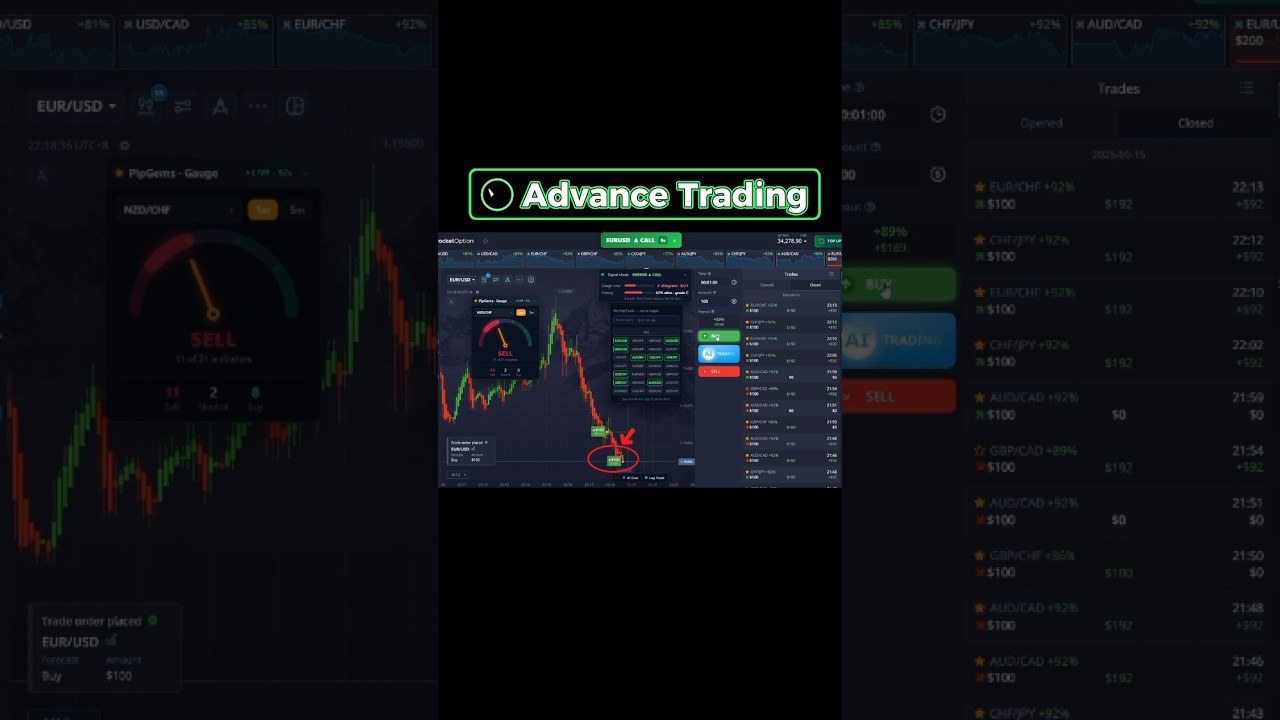
The three-minute vertical cut of this session — covered in part one — ends on a clean note: one loss, a recovery, two wins, +$342. This is the full 12-minute upload, and the other nine minutes tell a different and more useful story. Five more alerts fire. Entries are stacked three, four and finally seven deep. The account balance drops $1,100 from its high with $700 open on a single 1-minute expiry, and the session’s finish depends entirely on that seven-entry stack closing green.
It did. We logged every entry off the screen anyway, because a session that ends well is not the same as a method that works, and the difference is only visible in the log.
The Setup (Unchanged from Part One)
- Platform: Pocket Option, real account, Pro mode, desktop
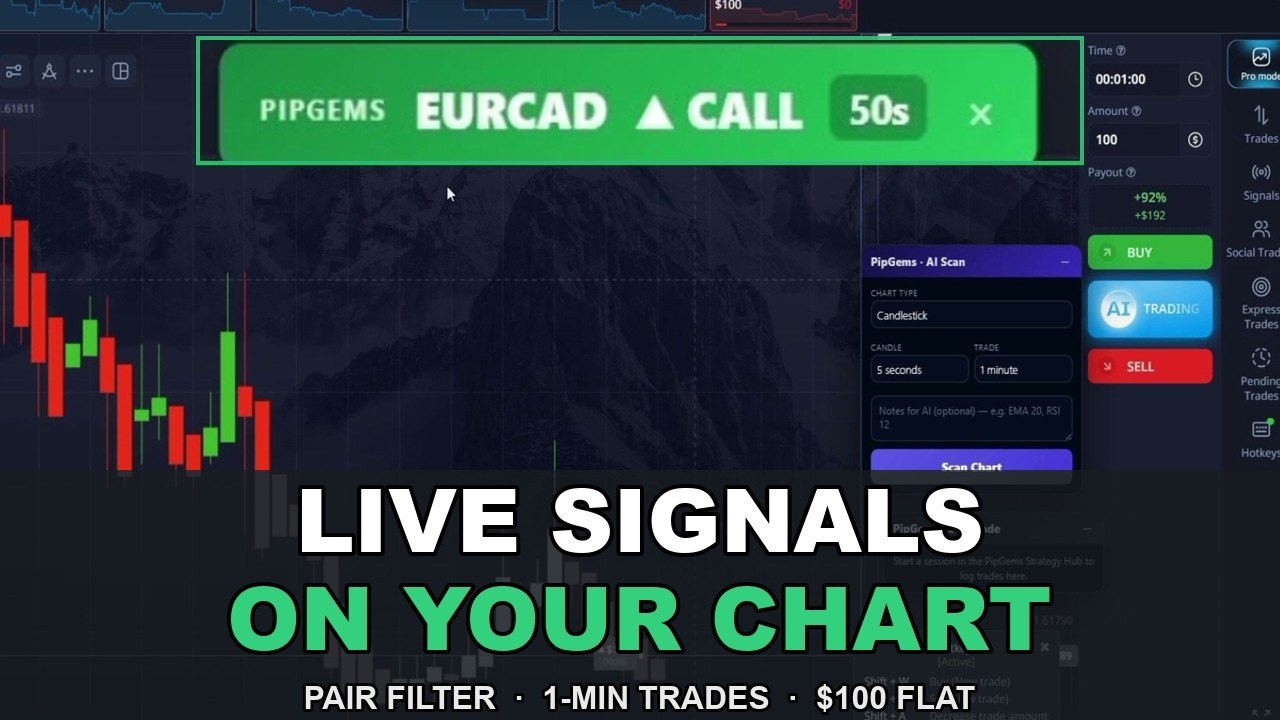
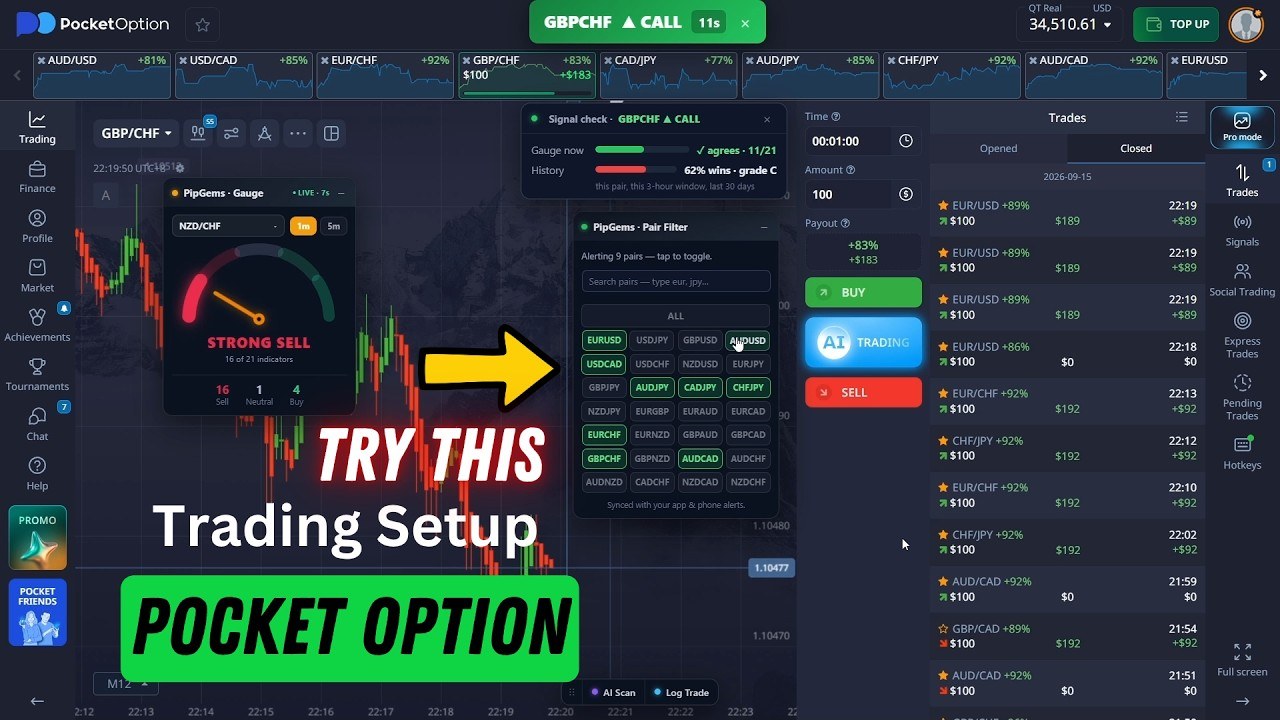
- Markets: nine non-OTC pairs synced in the PipGems Pair Filter — EUR/USD, AUD/USD, USD/CAD, AUD/JPY, CAD/JPY, CHF/JPY, EUR/CHF, GBP/CHF, AUD/CAD
- Trade duration: 1 minute on every entry; $100 per entry
- Check before entry: the Signal check card — does the gauge agree, and the signal’s 30-day win rate for this pair in this 3-hour window
- Narration: stops at about 3:00. Everything after that is alerts, clicks and music, so the second half is read from the screen alone.
Alert by Alert — the Second Half
Alert 4: EUR/CHF CALL (22:24) — gauge agrees 13/21, history 53%
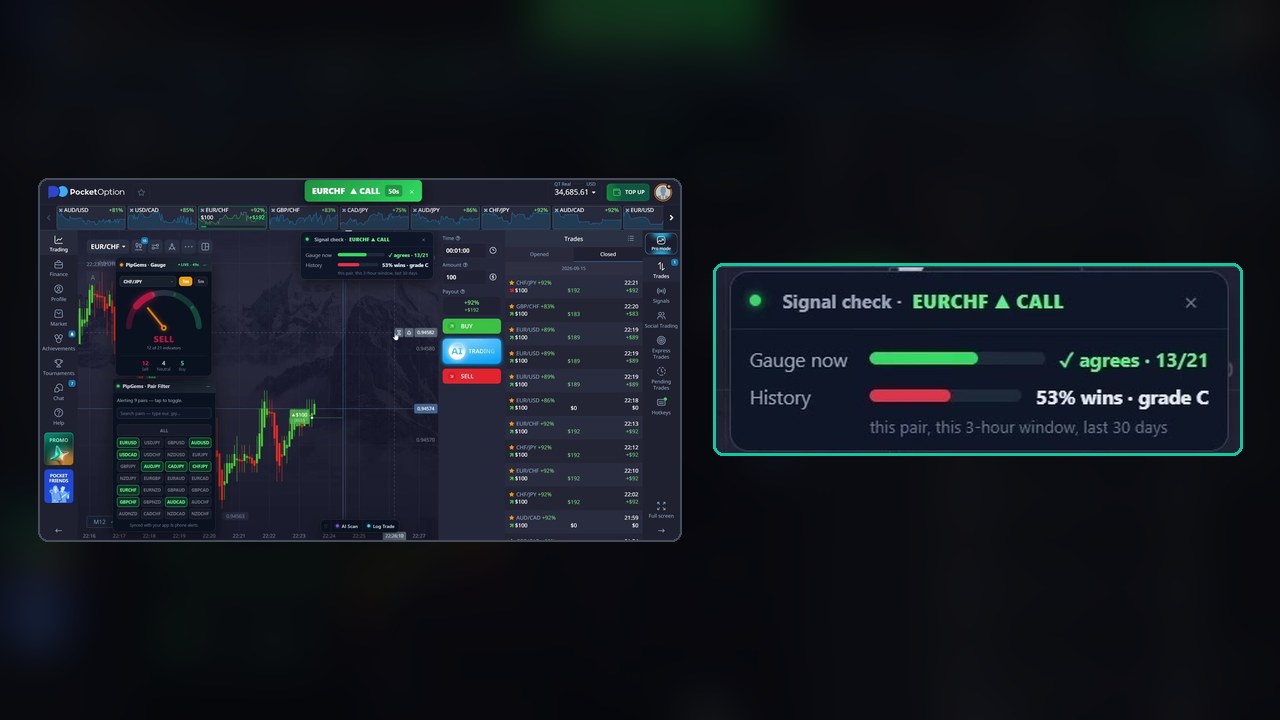
The first alert after the narration ends is the weakest reading of the session: the gauge agrees, but the 30-day history is only 53% — roughly break-even at a 92% payout. It is taken anyway, and then stacked: four $100 CALL entries within the minute.
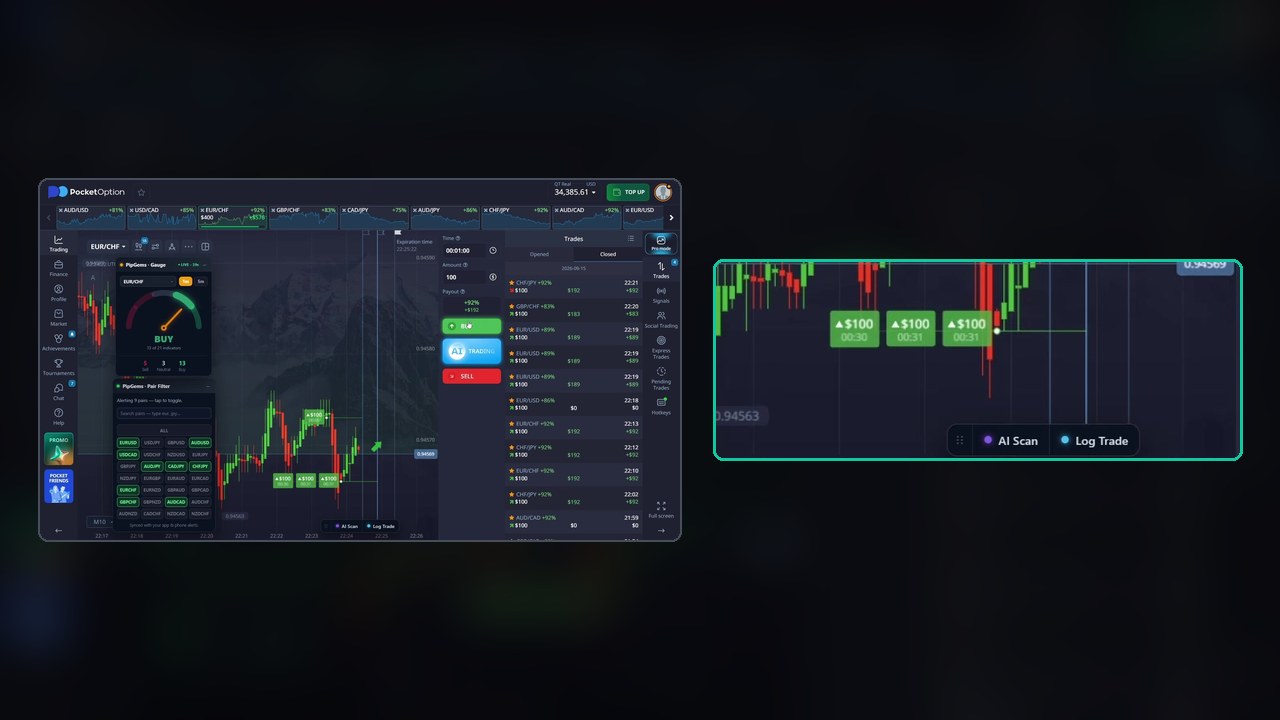
Result: one loss and three ties. The closed list shows three EUR/CHF entries returning exactly $100 — price closed at the entry level, so the stake came back with no profit — and one at $0. Net −$100 on $400 of exposure. A 53% signal did what a 53% signal does.
Alert 5: AUD/CAD PUT (22:26) — gauge agrees 13/21, history 71%
The strongest card of the session: gauge agrees, history 71%. One entry first, then three more stacked as price wobbled. Result: three wins at 92% ($192 each) and one loss. Net +$176. The stacking added profit here, and it also added a loss — the fourth entry, placed late, closed red.
Alert 6: GBP/CHF PUT (22:28) — gauge disagrees 4/21, history 62%
This is the alert the two-part check exists to catch. The gauge disagrees hard — only 4 of 21 indicators — on a chart that has been climbing for ten minutes. It is taken, and stacked to four entries.
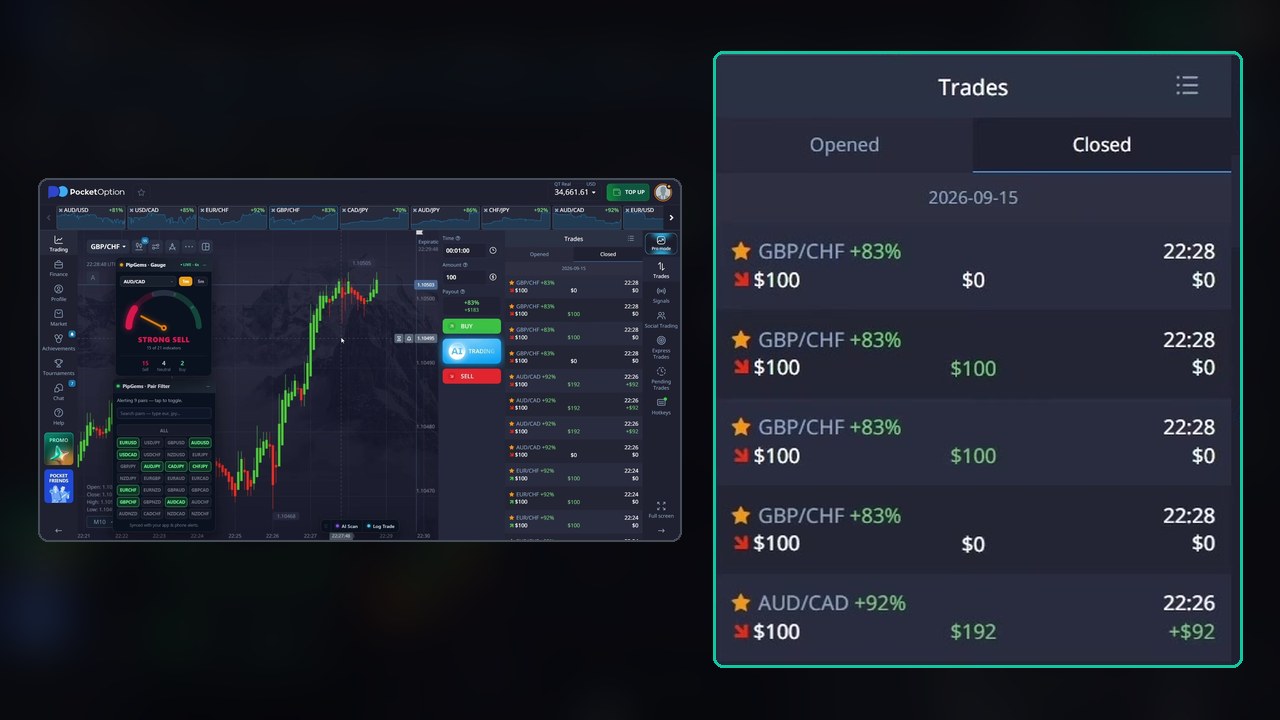
Result: two losses and two ties. Net −$200, the worst alert of the session. Nothing on the card supported the entry except the history line, and the history line was the same 62% that preceded the part-one loss.
Alert 7: AUD/CAD CALL (22:30) — gauge disagrees 2/21, history 71%
The only single-entry alert in the second half, and the most contradictory card: the gauge is at 2 of 21 against the signal, the history is 71% for it. One $100 CALL. Result: a win at 92%, +$92. Read that alongside alert 6 and you have the honest summary of what “gauge disagrees” predicted in this session: nothing reliable, in either direction.
Alert 8: AUD/JPY PUT (22:32) — gauge agrees 14/21, history 59%
Four $100 PUT entries go in during the first minute. All four close at $0. The balance, which peaked at $34,955 after alert 7, is now $34,353. Then, in the next minute, seven more $100 PUT entries are placed on the same pair.
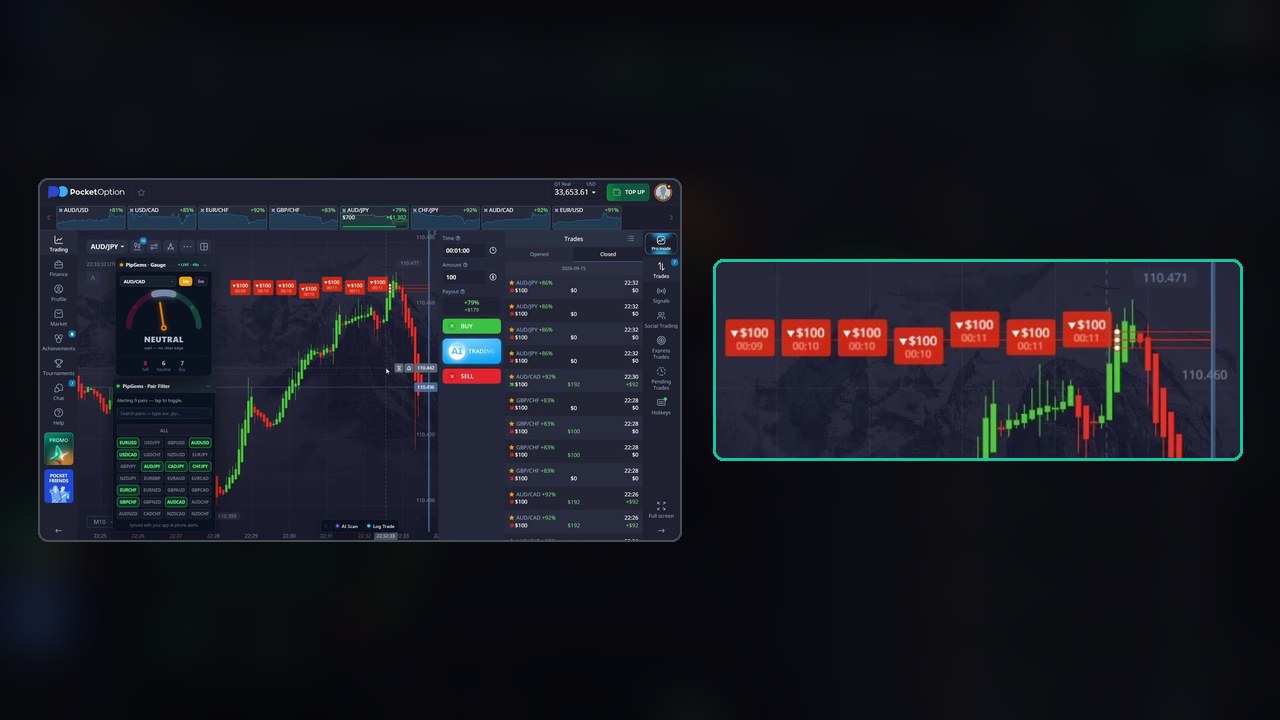
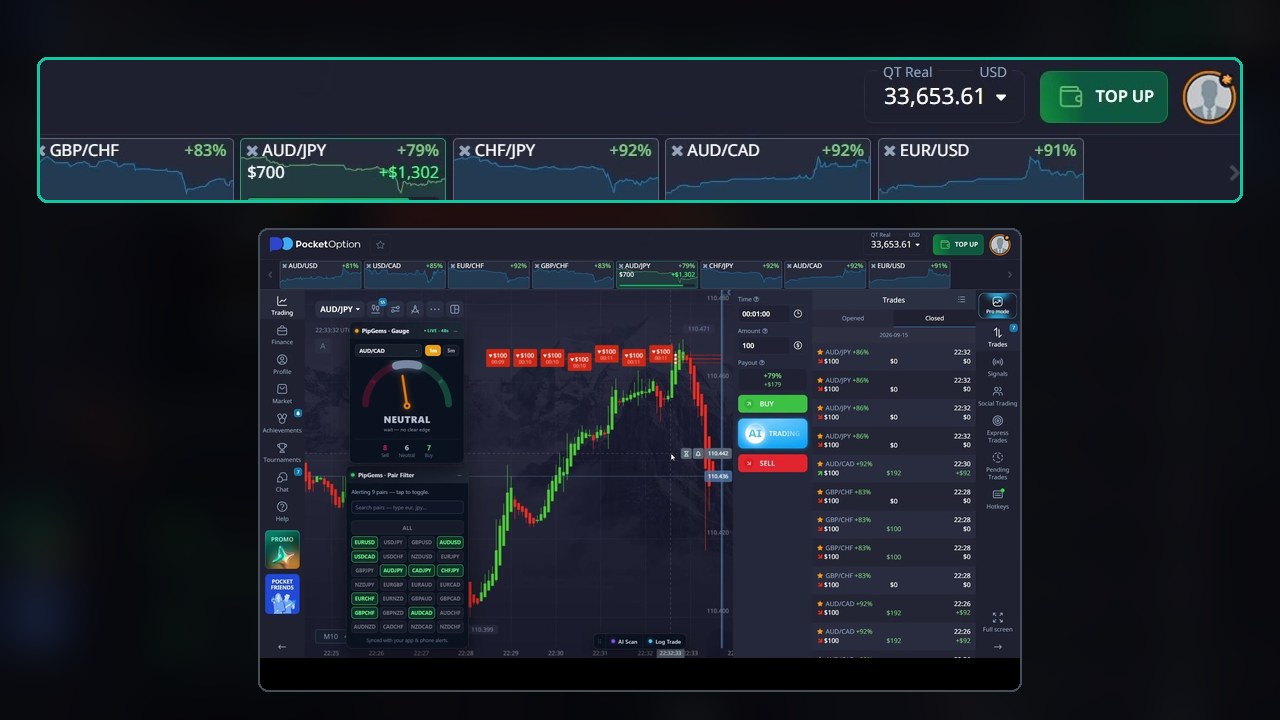
At that moment the account reads $33,653.61 with $700 open on one expiry — $1,100 below the session high, on a pair that has just lost four in a row. At 86% payout, five of the seven would have to win just to cover the four losses; four of seven would leave the alert net negative.
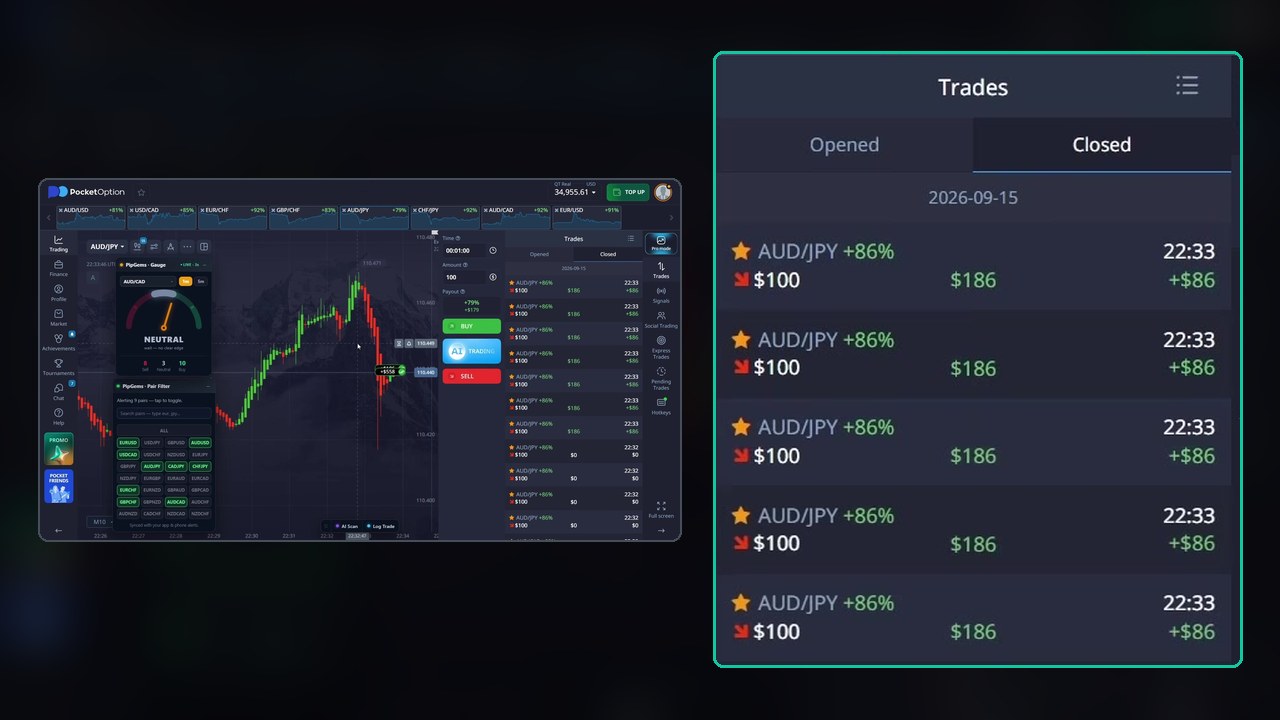
All seven closed green at $186. +$602 on the stack, +$202 net for the alert after the four losses, and the balance finishes at $34,955.61. That single minute is the difference between the session ending up and ending down.
The Whole Session, Reconciled
Start of the upload: $34,443.61. End: $34,955.61. Net +$512.00 over 12½ minutes. That is the figure the trades have to add up to, and they do:
- Part one (alerts 1–3): 6 entries — 5 wins, 1 loss — +$342
- EUR/CHF CALL: 4 entries — 0 wins, 3 ties, 1 loss — −$100
- AUD/CAD PUT: 4 entries — 3 wins, 1 loss — +$176
- GBP/CHF PUT: 4 entries — 0 wins, 2 ties, 2 losses — −$200
- AUD/CAD CALL: 1 entry — 1 win — +$92
- AUD/JPY PUT: 11 entries — 7 wins, 4 losses — +$202
Thirty entries: 16 wins, 9 losses, 5 ties. Gross profit on the winners $1,412, gross loss on the losers $900, net +$512 — matching the balance to the cent. Ties are not free either: five stakes sat at risk for a minute each and returned nothing.
What the Stacking Actually Did
Strip the stacking out and look at the eight alerts as eight single $100 entries. The card readings and the first result of each alert do not line up in any way you could trade on: the two “gauge disagrees” alerts split one loss and one win; the 71% history won twice and the 53% history lost; the 59% history lost four times in a row before winning seven. On one entry per alert this session is somewhere close to flat.
The stacking is where the +$512 came from — and it is also where the $1,100 drawdown came from, and the $700 single-minute exposure, and a session outcome that hinged on one stack of seven. The signals did not make this session; the stake sizing did. That cuts both ways, and the second half shows the cutting: two of the four stacked alerts finished net negative.
The clip is honest about what it is doing, and the narration in part one names it as the Martingale method. We show it because it is on the screen. We do not recommend it, and this half is the reason why: the same behaviour that produced the finish produced a −$400 minute on AUD/JPY, and nothing about the next seven entries was more informed than the four that lost.
What Is Worth Copying
- The pair filter sync. Nine pairs open, nine pairs alerting. Every alert had its chart and payout one click away.
- Reading the card before every click. Even when the trader overrode it, the reading was on screen. That is the habit; the override is the mistake.
- A written rule for the card. This session never had one. “Skip when the gauge disagrees, skip when history is under 60%” would have removed alerts 1, 4, 6 and 7 — two losses, one flat, one win.
- One entry per alert, flat stake. Let a logged sample of fifty alerts tell you whether the check clears the roughly 53% break-even at these payouts.
- Log ties as well as wins and losses. Five of thirty entries here were ties. A win rate that ignores them overstates the edge.
Watch the Full Session
Twelve and a half minutes — the narrated setup, then every alert and every stack:
Honest Weaknesses
- The finish is one stack. Remove the seven AUD/JPY wins and the session is −$90. That is not a robust result; it is a good minute.
- No narration after 3:00. The reasoning behind stacking four entries on a 53% card, or seven after four losses, is never stated. We can log what happened; we cannot tell you why.
- Eight alerts is a tiny sample for judging the gauge-agree line or the history percentages, and the results here are mixed enough that no conclusion survives it.
- Grade C throughout. Every card in the session carried a C. The clip never shows what an A or B looks like, or whether waiting for one would have changed the results.
Risk Management
- One flat stake per alert. No second entry on the same signal, no stacking after a loss.
- Set a per-session loss limit in dollars before you start — this session would have hit a $500 limit at 22:33 and never placed the seven.
- Break-even at these payouts: about 52% at 92%, 54% at 86%, 55% at 83%. A 53% history is not an edge at any of them.
- Test on a demo account with the log open, and only move to real money with a sample behind you.
Frequently Asked Questions
How did the full session end?
The account moved from $34,443.61 to $34,955.61, a net +$512 over about 12½ minutes, across 30 entries: 16 wins, 9 losses and 5 ties. The per-trade payouts reconcile to that balance change exactly.
What was the biggest drawdown?
After four losing AUD/JPY entries and seven more placed on the same pair, the balance read $33,653.61 with $700 open — $1,100 below the session high a few minutes earlier. All seven then closed green at 86%.
Did the gauge-agree reading predict the results?
Not in this sample. Of the two alerts the gauge disagreed with, one lost twice and one won. The 71% history alert won three of four and the 53% alert lost. Eight alerts is far too few to judge the card either way.
Is stacking entries part of the strategy?
The narration in part one calls it the Martingale method, and the second half stacks up to seven entries on one alert. It produced most of the session’s profit and all of its drawdown. We show it because it is in the video; we do not recommend it.
The Verdict
4 out of 5. As a record it is unusually complete: a real account, twelve uncut minutes, the closed-trades list on screen throughout, and a balance that reconciles to the cent. The pair-filter sync and the card-before-click habit are worth copying exactly as shown.
It loses a star for what the second half reveals: the session’s result comes from stake sizing rather than from the signals, the card readings were overridden as often as followed, and a seven-entry stack after four straight losses is the kind of decision that ends other sessions. Take the log, take the routine, and write the rule the clip never states.
#PocketOption #PipGems #AISignals #LiveSession #1MinuteTrades #NonOTC #BinaryOptions #TradingLog #RiskManagement
This content is for educational purposes only and is not financial advice. Trading involves substantial risk; you can lose some or all of your capital. No result is guaranteed and past results do not indicate future outcomes. Always practise responsible money management, limit your daily trades, and trade only what you can afford to lose.
Start with part one for the narrated setup and the first three alerts, see the payout filter for why the 83% pairs cost more to trade, and browse the strategy library for everything else on this platform.