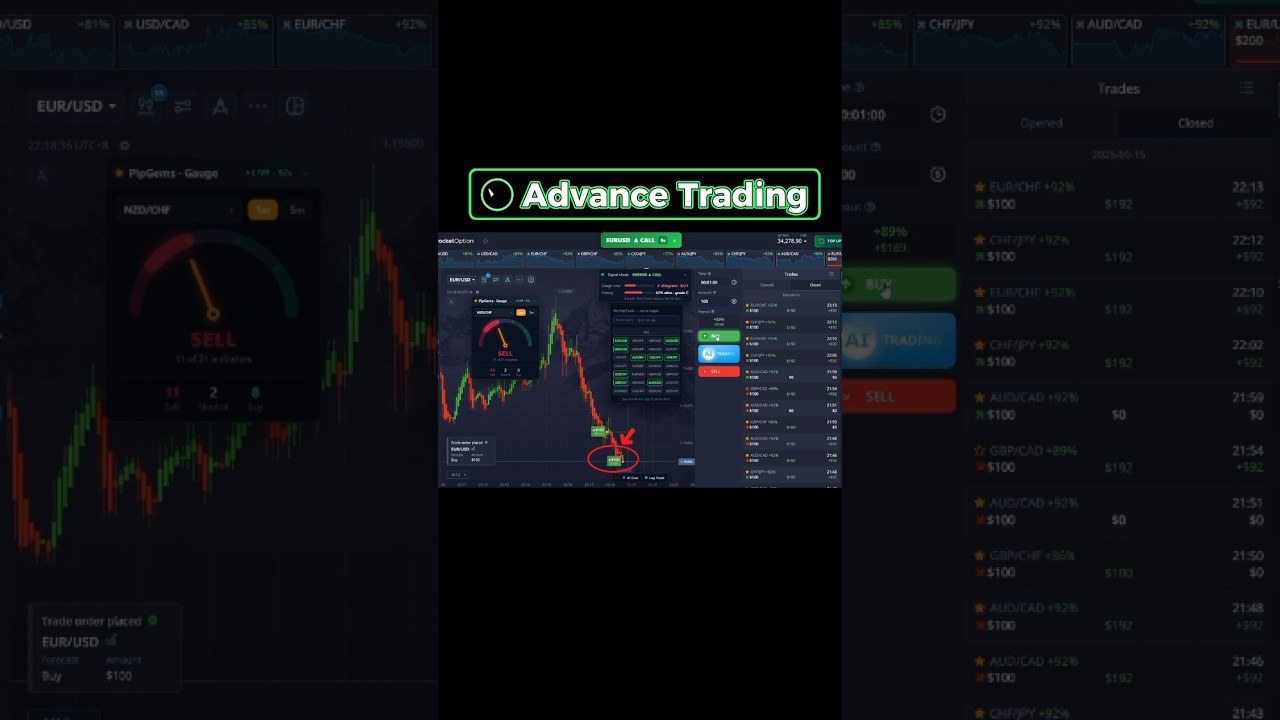
The Idea in One Sentence
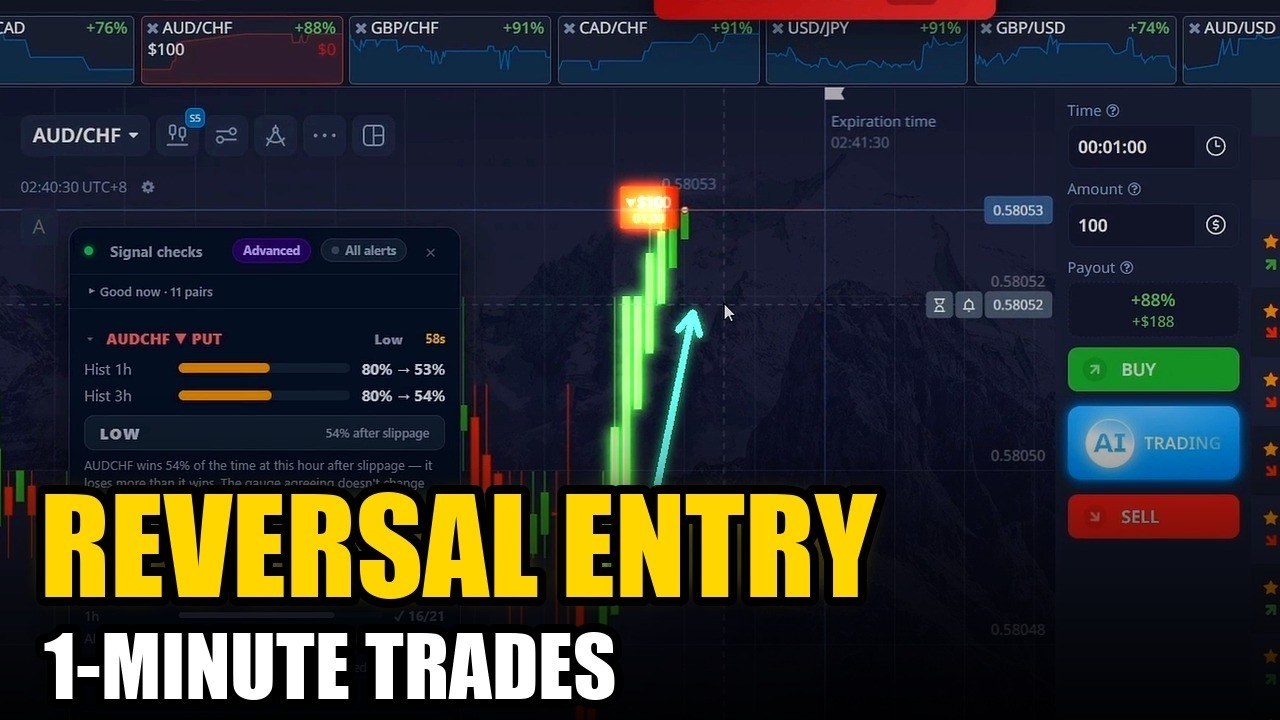
Find a currency pair that is going nowhere, then fade the fast moves: sell a quick push up, buy a quick drop down, and let a 1-minute trade ride the snap-back. That is the whole rule. The PipGems Gauge tells you which pairs are neutral; the 5-second candles show you the push.
The session runs on a Pocket Option real account (the balance reads QT Real), $50 per trade, regular pairs only. We checked every trade against the balance: 7 trades, 5 wins, 1 draw, 1 loss, +$164. The balance moved from $25,669.61 to $25,833.61, which is exactly that total.
Step 1 — Regular Pairs With a High Payout
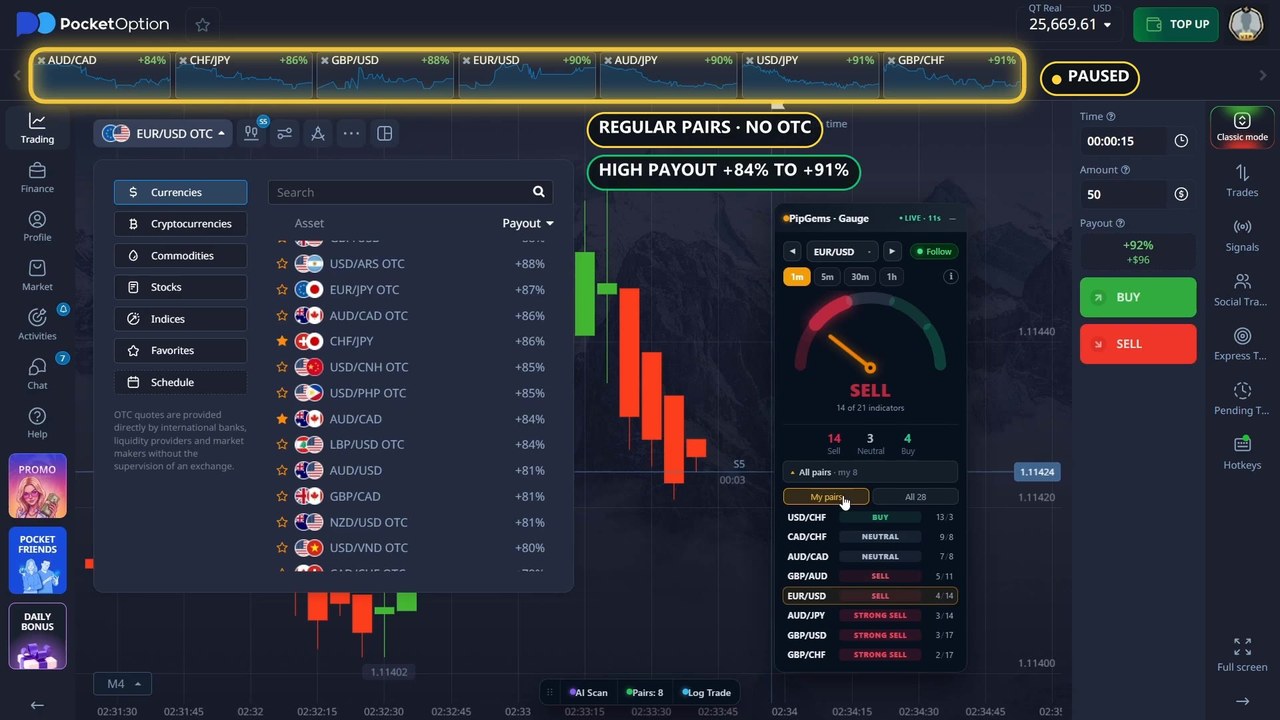
The first filter is the pair list. OTC pairs are out. The open tabs are all regular market pairs — AUD/CAD, CHF/JPY, GBP/USD, EUR/USD, AUD/JPY, USD/JPY, GBP/CHF — with payouts between +84% and +91% when the video starts. A higher payout lowers the win rate you need to break even, which matters a lot on 1-minute trades.
Step 2 — Read the Gauge and Find the Neutral Pairs
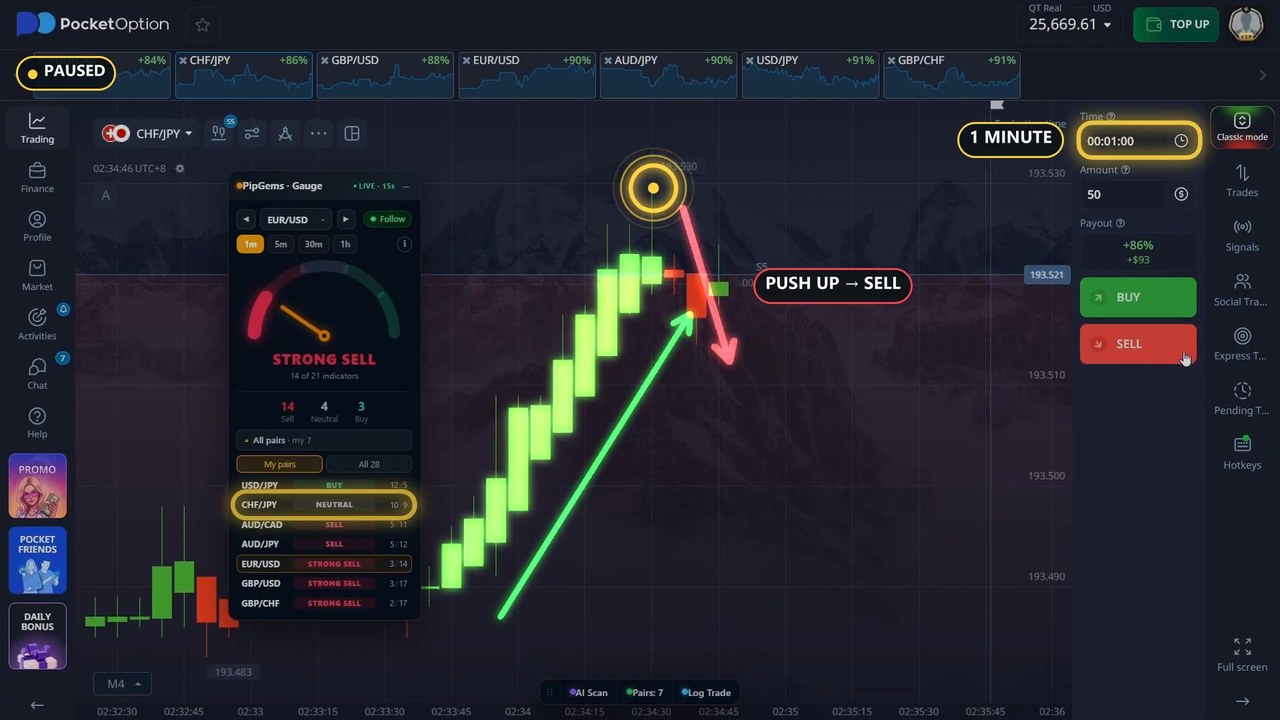
The PipGems Gauge counts how many of its 21 indicators say sell, neutral or buy. The big dial follows one pair (EUR/USD here, at Strong Sell, 14 of 21). The part that matters for this rule is the My pairs list underneath: each pair you follow gets its own reading and a buy/sell count.
- Strong Buy / Strong Sell — the indicators agree. A fast push here is usually the trend, not a spike to fade.
- Neutral — the indicators are split, for example CHF/JPY at 10/9. This is the kind of pair the rule is built for.
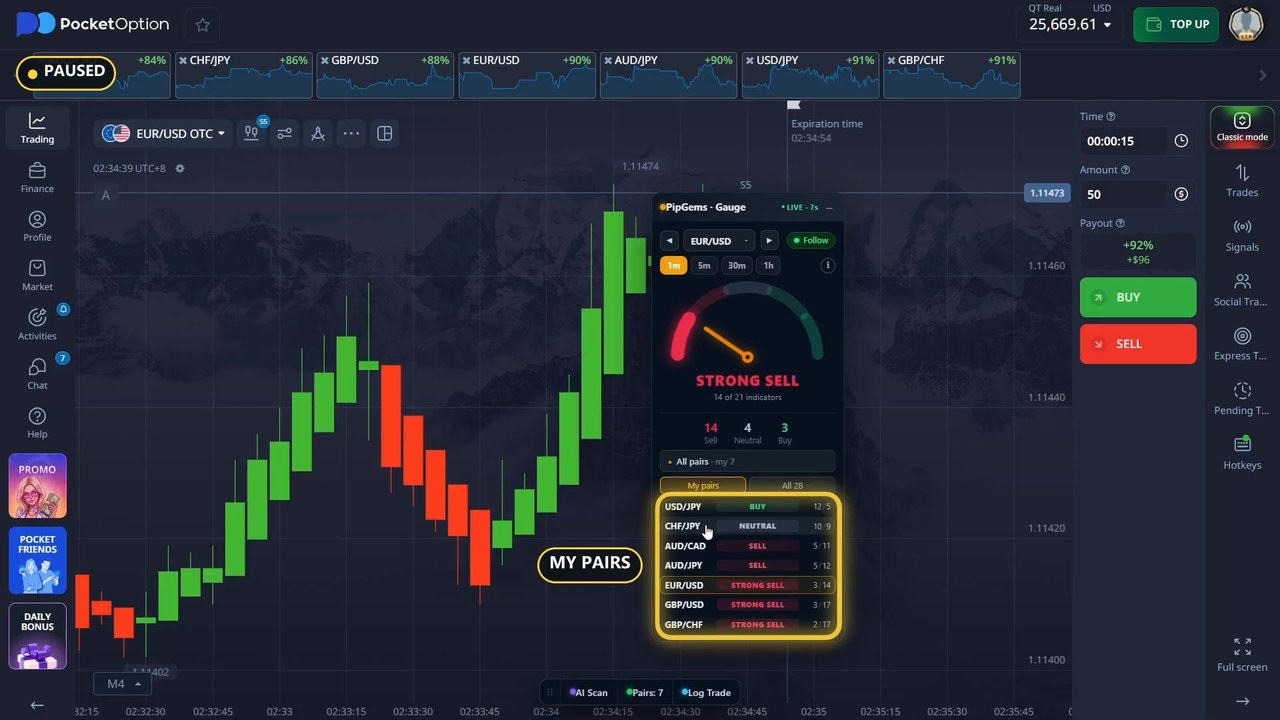
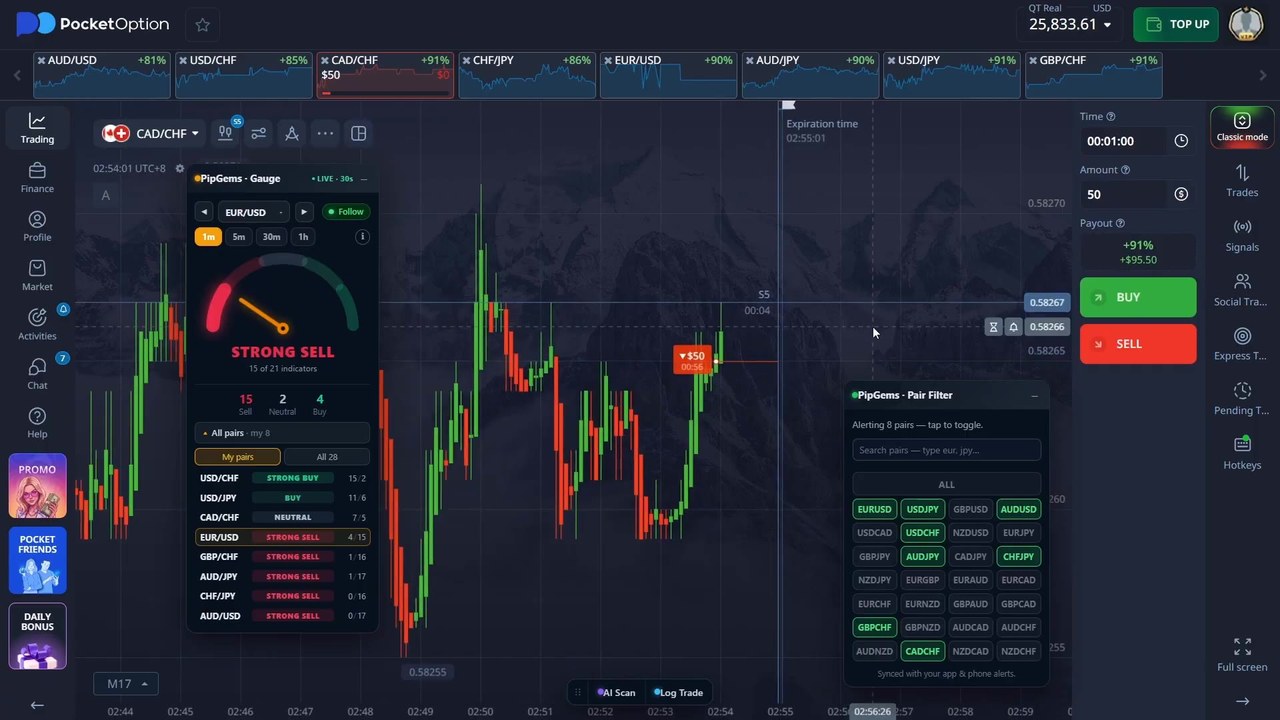
The trader also used the Pair Filter to choose which pairs send alerts, then switched to whichever neutral pair was moving.
Step 3 — Wait for the Push on 5-Second Candles
With the pair chosen, the chart goes to 5-second candles. On that timeframe a burst of buying or selling shows up as a run of tall candles in one direction within a few seconds. That burst is the signal:
- Quick push up → SELL for 1 minute.
- Quick drop down → BUY for 1 minute.
Trade 1 is the textbook case. CHF/JPY was Neutral (10/9) on the gauge, a string of green 5-second candles ran straight up, and the trader sold at the top for 1 minute at an 86% payout. It closed in profit, +$43.
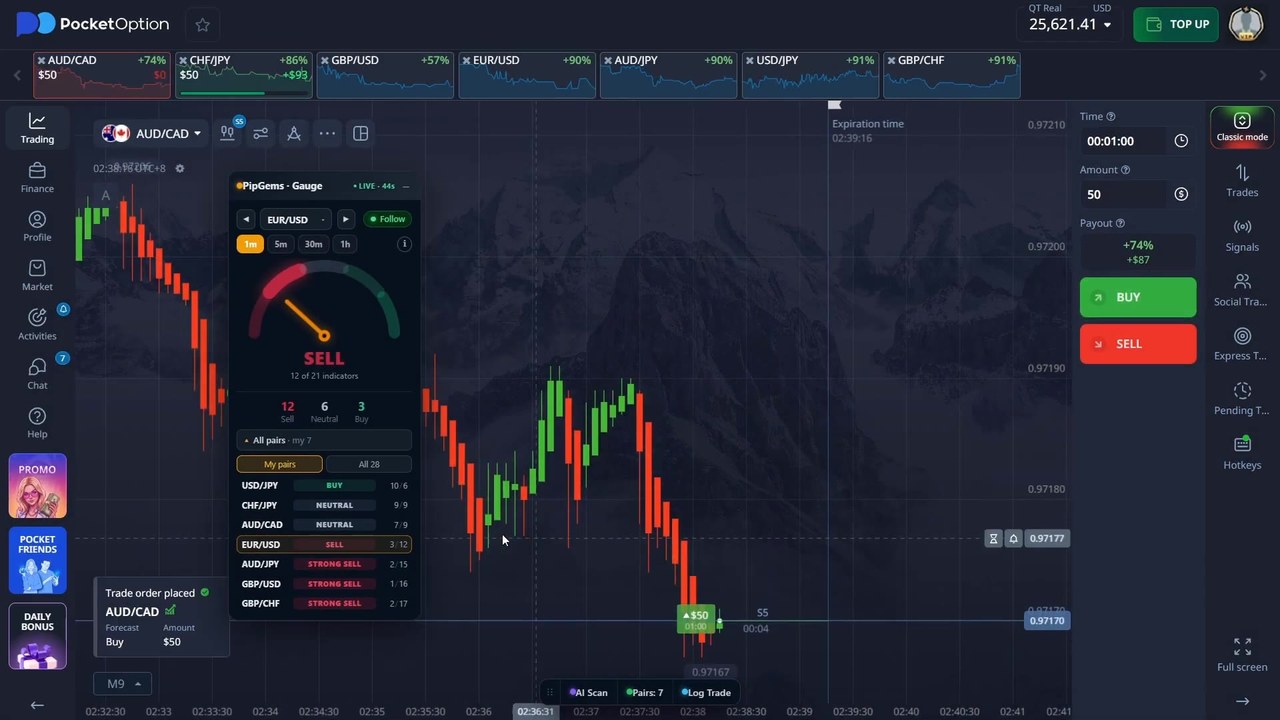
Trade 3 is the mirror image. AUD/CAD (Neutral, 7/9) dropped hard in a few seconds, and the trader bought at the bottom. It won, but at a lower 74% payout, so the same $50 paid only +$37.
Knowing When Not to Trade
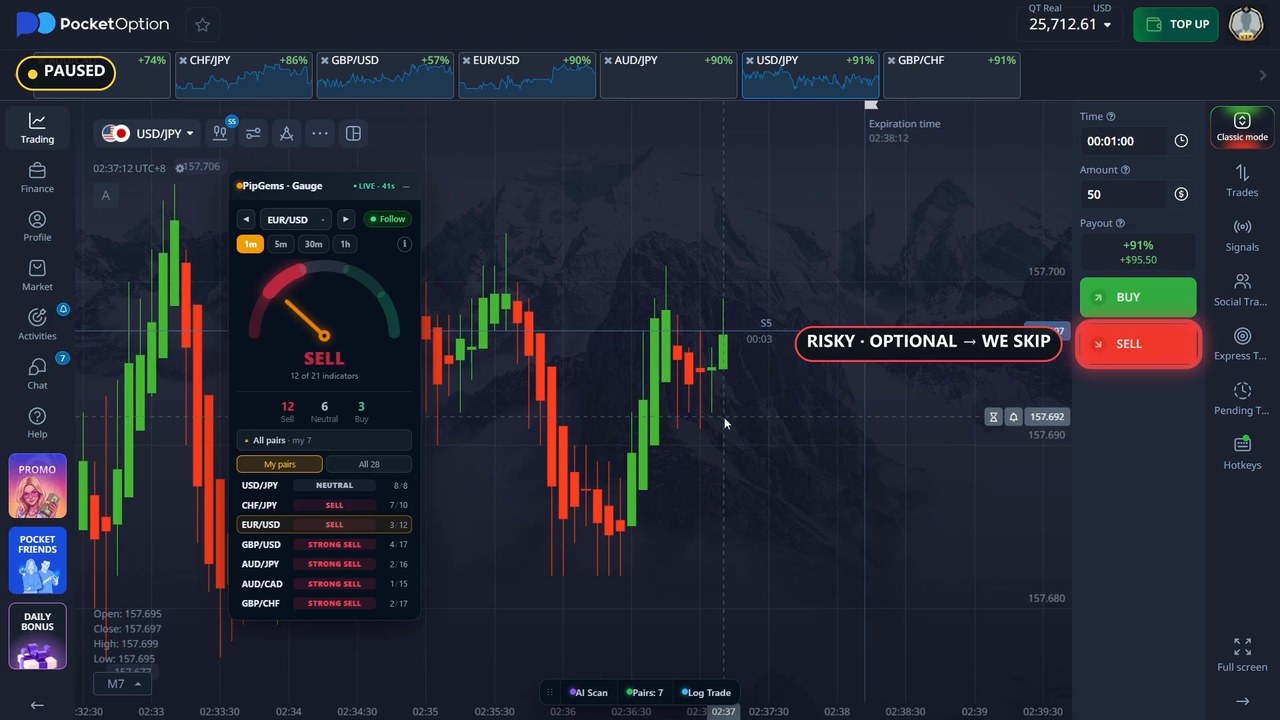
Just as useful is the setup the trader did not take. USD/JPY was chopping up and down with no clean push either way. The video marks it “Sideways · no clear push” and then “Risky · optional → we skip”. With no impulse there is nothing to fade, so there is no trade.
All 7 Trades
| # | Video | Pair | Trade | Gauge row (buy/sell) | Payout | Result | P/L |
|---|---|---|---|---|---|---|---|
| 1 | 2:30 | CHF/JPY | SELL | Neutral (10/9) | 86% | Win | +$43.00 |
| 2 | 4:50 | CHF/JPY | SELL | Neutral (9/9) | 86% | Win | +$43.00 |
| 3 | 5:40 | AUD/CAD | BUY | Neutral (7/9) | 74% | Win | +$37.00 |
| 4 | 7:40 | CHF/JPY | BUY | Neutral (10/8) | 86% | Draw | $0.00 |
| 5 | 9:40 | GBP/CHF | SELL | Strong Sell (2/14) | 91% | Win | +$45.50 |
| 6 | 12:00 | CAD/CHF | BUY | Neutral (7/6) | 91% | Win | +$45.50 |
| 7 | 14:00 | CAD/CHF | SELL | Neutral (7/5) | 91% | Loss | −$50.00 |
Every result above comes from the balance: a $50 drop when a trade opens, then the stake plus the payout back for a win, the $50 back for a draw, and nothing for a loss.
Two Things the Table Shows
Trade 5 broke the rule. GBP/CHF was not neutral; the gauge had it at Strong Sell (2/14). The trader sold a push up, so that trade went with the gauge rather than fading a neutral range. It won, but it is a different setup, and if you are testing the neutral-pair rule on its own you should log trades like this separately.
The only loss was the last trade. CAD/CHF had just given a clean win on a quick drop (trade 6). Two minutes later it pushed up, still Neutral (7/5), and the trader sold — but the price kept climbing and the trade lost the full $50. A neutral reading does not stop a pair from starting a new move.
Watch the Video
The full session, including the skipped USD/JPY setup and the losing CAD/CHF trade. The waits between trades are sped up in the video.
Honest Weaknesses
- Seven trades. One good session proves nothing on its own. You need dozens of logged trades before a win rate means anything.
- “Quick push” is a judgement call. The video gives no exact size or number of candles, so two traders can read the same chart differently. Write down your own definition before you start.
- The payout varies. AUD/CAD paid 74% while CAD/CHF and GBP/CHF paid 91%. At 74% you need about 57% wins to break even; at 91%, about 52%.
- Not every trade was a neutral-pair fade. Trade 5 was taken on a Strong Sell pair.
- Speed matters. The entry is at the end of a burst that lasts seconds. A slow click on a real account means a worse price.
How to Test It Yourself
- Choose regular pairs with a payout of about 85% or more, and skip OTC.
- Only trade pairs the Gauge shows as Neutral, and write the gauge reading next to each trade.
- Define the push in advance (for example, at least four same-colour 5-second candles in a row) and only trade when you see it.
- Trade 1 minute at one flat stake, and skip anything sideways.
- Log 50 trades on a demo account and compare your win rate with the break-even for your payout.
Risk Management
- One stake for the whole session — no doubling up after a loss.
- Set a daily loss limit and a maximum number of trades, and stop at either.
- Know your break-even: about 52% at a 91% payout, 54% at 86%, 57% at 74%.
- Practise on a demo account first, and never trade money you cannot afford to lose.
Frequently Asked Questions
What is the 5-second candle rule on Pocket Option?
Pick a pair the PipGems Gauge lists as Neutral, put the chart on 5-second candles, and wait for a fast impulse. When price shoots up quickly you sell; when it drops quickly you buy. Every trade is 1 minute. The idea is that a pair with no clear direction tends to give a quick push back.
Why trade only neutral pairs?
On a pair the Gauge rates Strong Buy or Strong Sell, a fast push is often the trend continuing, so fading it means trading against the flow. On a Neutral pair the indicators are split, so a sharp move has a better chance of snapping back inside its range. That is the reasoning in the video; it is a premise to test, not a rule that always holds.
Does this work on OTC pairs?
This session used regular currency pairs only, with payouts between 74% and 91%. Nothing was tested on OTC, and OTC prices come from the broker's own feed, so the result says nothing about OTC pairs.
What was the result in the video?
Seven trades at $50 each on a Pocket Option real account: 5 wins, 1 draw and 1 loss, for +$164. The balance went from $25,669.61 to $25,833.61, which matches the trade-by-trade total.
When should you skip a setup?
When there is no clean impulse. In the video USD/JPY was chopping sideways with no clear push in either direction, so the trader passed on it. If you cannot point at the push you are fading, there is no trade.
The Verdict
4.5 out of 5. A simple rule you can explain in one sentence, used on regular pairs with a good payout, and shown honestly on a real account — including a skipped setup, a draw and a loss. The balance adds up to the cent: 7 trades, 5 wins, +$164.
The missing half star: seven trades is a demonstration, not proof, and the “quick push” is still judged by eye. Give it a firm definition, log your own sample on demo, and keep it only if your numbers clear the break-even.
#PocketOption #PipGems #TradingStrategy #1MinuteTrading #BinaryOptions #PriceAction
This content is for educational purposes only and is not financial advice. Trading involves substantial risk; you can lose some or all of your capital. No result is guaranteed and past results do not indicate future outcomes. Always practise responsible money management, limit your daily trades, and trade only what you can afford to lose.
Related reading: the PipGems Pair Filter, Gauge and history check on Pocket Option, the PipGems AI Scanner on a real account, and low-history alerts traded as reversals. For more, see the Pocket Option hub and the strategy library.