How We Picked These Six
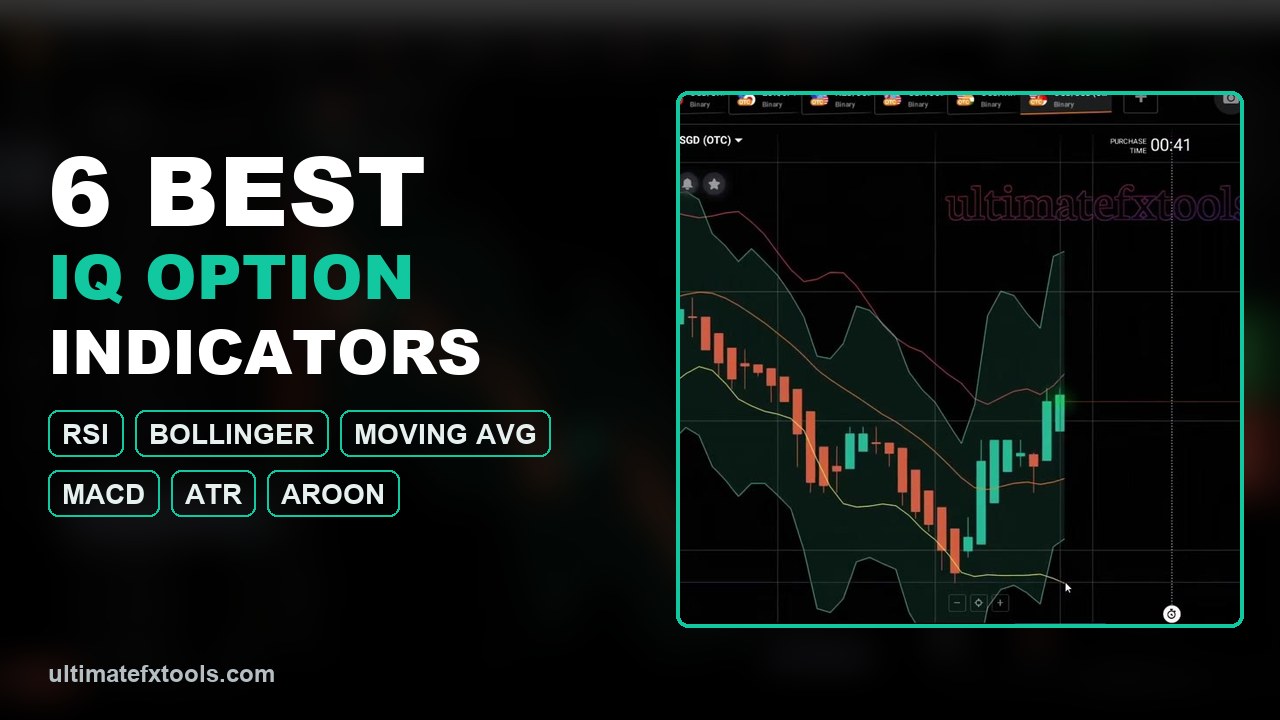
We did not pick these from a generic “top indicators” list. We went through the 84 IQ Option strategies on this site and counted which indicators actually do the work in them. Six came out on top, and every one of them is built into IQ Option — nothing to download, no MetaTrader, no paid tool:
| # | Indicator | Job | Starting settings |
|---|---|---|---|
| 1 | RSI | Timing: overbought / oversold | Period 14, levels 70 / 30 (80 / 20 on fast charts) |
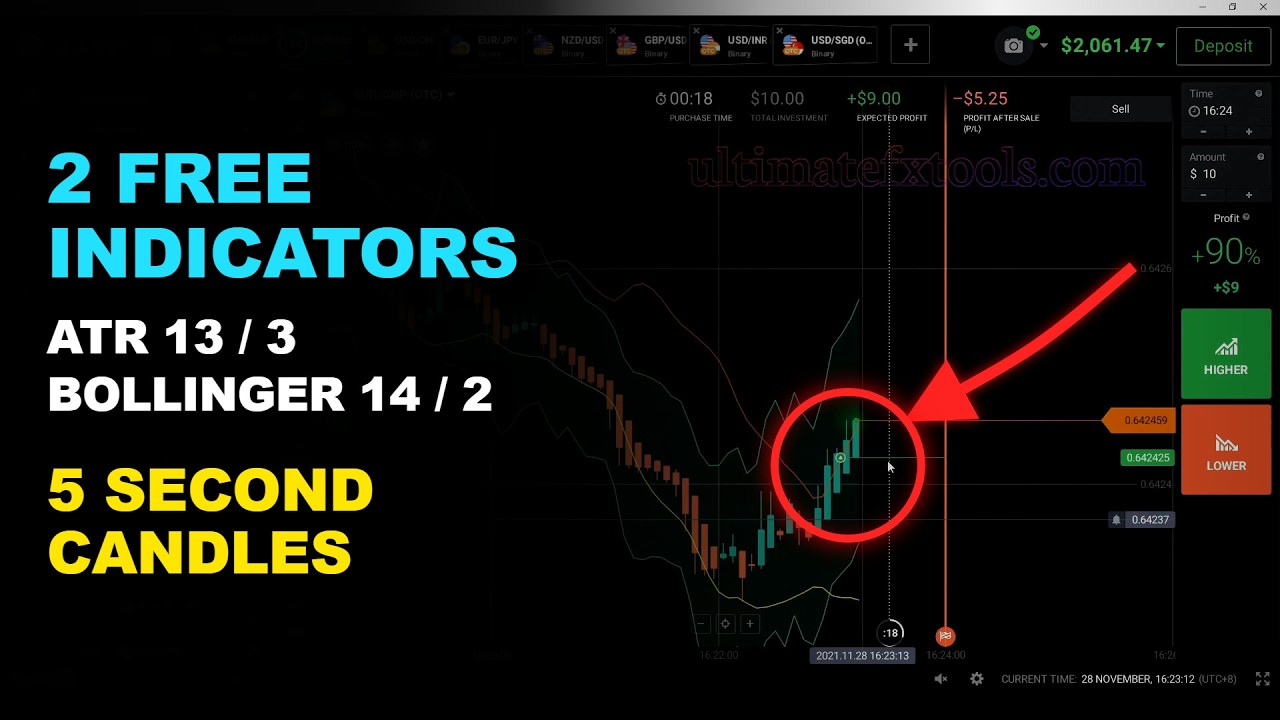
| 2 | Bollinger Bands | Stretch and volatility | Period 20, deviation 2 (shorter on 5–10s candles) |
| 3 | Moving averages (EMA / SMA / WMA) | Trend direction | A fast and a slow line, e.g. EMA 30 + EMA 50 |
| 4 | MACD | Momentum shifts | 12, 26, 9 |
| 5 | ATR | Filter: is the market moving? | Period 14 |
| 6 | Aroon | Trend start and strength | Period 14 |
To add any of them, open the Indicators menu at the bottom of the IQ Option chart, search by name, set the period and apply. Keep it to two or three at a time — every extra line makes the chart harder to read, not more accurate.
1. RSI — the Timing Tool
The Relative Strength Index measures how far and how fast price has moved recently, on a 0–100 scale. Above 70 is “overbought”, below 30 “oversold”. It is the most common indicator in our IQ Option posts because it answers the question every short-expiry trader has: has this move gone too far?
- Settings: period 14 with 70 / 30. On 15-second or faster candles, widen to 80 / 20 so you only react to real extremes.
- Best for: 60-second and shorter expiries, when paired with something that confirms the turn.
- Watch out: in a strong trend RSI can sit above 70 for a long time. “Overbought” is not a sell signal by itself.
See it in action: RSI alert for 60-second trades and RSI + Aroon on 15-second candles.
2. Bollinger Bands — Stretch and Volatility in One
Bollinger Bands draw a channel around a moving average, set a number of standard deviations wide. When price pokes outside the band it is stretched; when the bands squeeze together the market is quiet and a breakout is building.
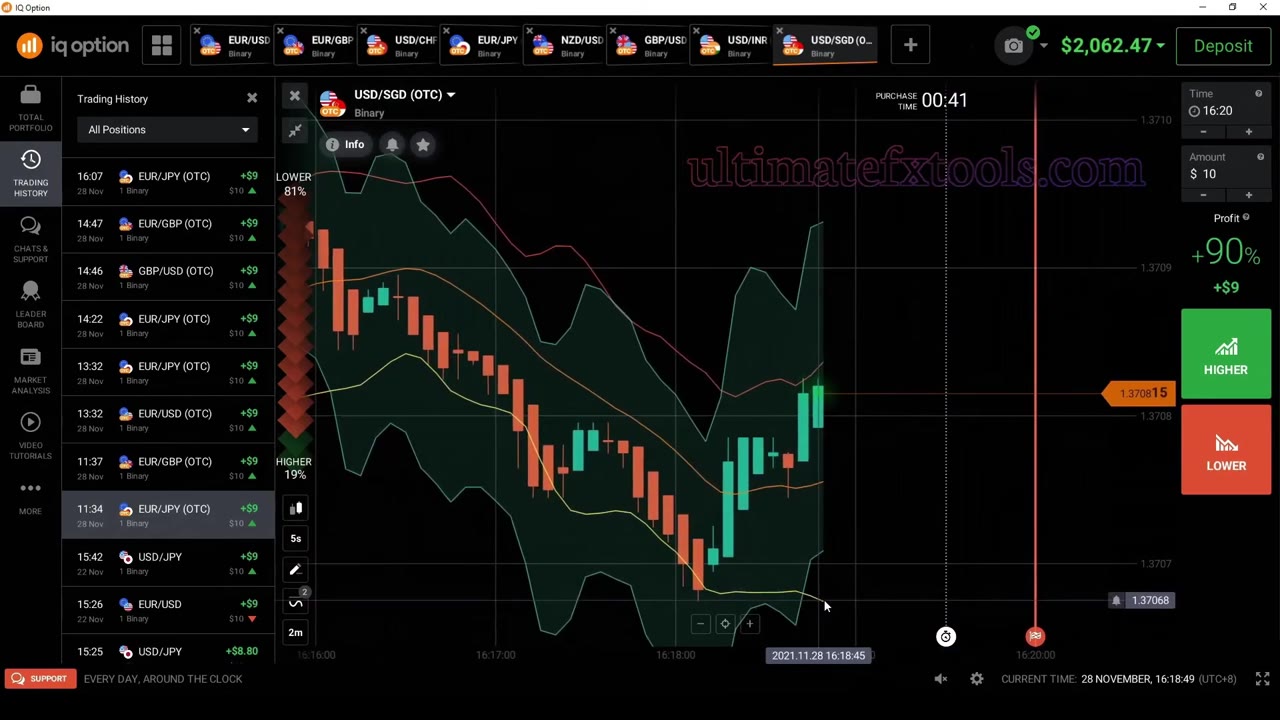
- Settings: the classic 20 / 2. On very fast charts our posts go shorter: period 14, deviation 2 on 5-second candles, and period 12, deviation 3 on 10-second candles.
- Best for: snap-back entries after a close outside the band, and spotting a squeeze before a move.
- Watch out: in a breakout, price can “walk the band” for many candles. Pair it with RSI or ATR before fading a move.
See it in action: ATR + Bollinger Bands on 5-second OTC and Bollinger on 10-second Blitz candles.
3. Moving Averages — Which Way Is the River Flowing?
Moving averages smooth price into a line so you can see the trend. IQ Option offers several types: the SMA weights every candle equally (smooth, slow), the EMA favours recent candles (faster), and the WMA sits in between.
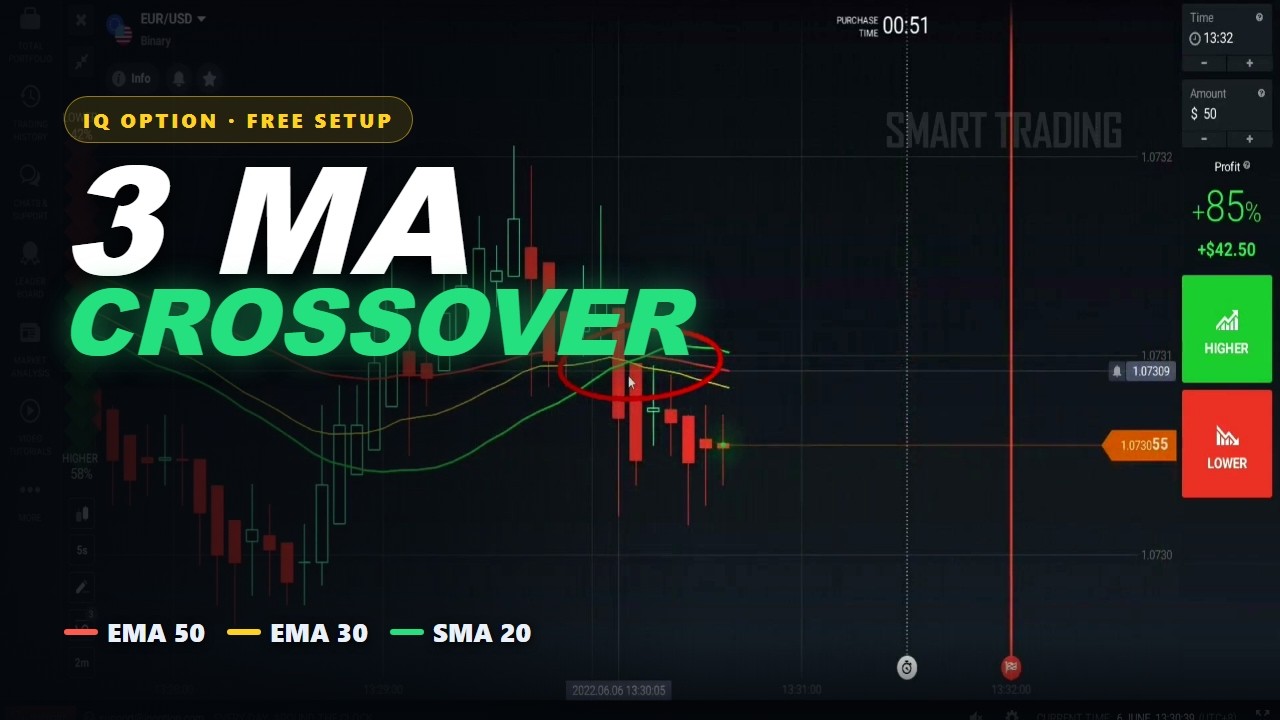
- Settings: use two or three lines, a fast one and a slow one. Examples from our posts: EMA 50 + EMA 30 + SMA 20 for a crossover setup, or a fast WMA near 12 with a slow WMA near 50.
- Best for: deciding direction. Only take CALLs above the slow line and PUTs below it, and let another indicator time the entry.
- Watch out: when the lines are tangled together, there is no trend — crossovers there are noise.
See it in action: 3 moving average crossover and the weighted moving average strategy.
4. MACD — Momentum Changing Gear
MACD tracks the gap between a fast and a slow EMA, plus a signal line. When the MACD line crosses its signal line, or the histogram flips from red to green, momentum is changing direction.
- Settings: the default 12, 26, 9 is fine; there is no need to optimise it.
- Best for: 1-minute and longer expiries, and confirming that a trend is still alive.
- Watch out: MACD lags. On 5–15 second candles it often confirms a move after it is already over.
See it in action: MACD trend detector.
5. ATR — the Filter Nobody Talks About
The Average True Range does not tell you direction at all. It tells you how much price is moving. That makes it the most underrated tool on this list: it is the one that keeps you out of dead markets where even a correct call does not travel far enough before expiry. It is also the single most common indicator across our IQ Option posts.
- Settings: period 14. (Our Advance ATR post uses an ATR trailing-stop version at period 16, multiplier 2.)
- Best for: a go / no-go check. Rising ATR: the market has energy. Flat, low ATR: skip.
- Watch out: a spike in ATR after news can mean chaos, not opportunity.
See it in action: Advance ATR trading and ATR + Aroon.
6. Aroon — Is a New Trend Starting?
Aroon has two lines, Up and Down, that measure how recently price made a new high or low. When Aroon Up crosses above Aroon Down and pushes toward 100, a new up-move is taking over, and vice versa.

- Settings: period 14.
- Best for: catching the start of a trend and confirming its strength.
- Watch out: when both lines hover in the middle, there is no trend. Stand aside.
See it in action: ATR + Aroon.
The Pairings That Work
None of these is meant to be used alone. The combinations that come up again and again in our IQ Option strategies follow one pattern: one tool for direction or stretch, one for timing, one filter.
- RSI + Bollinger Bands — price outside the band and RSI at an extreme. The classic snap-back.
- ATR + Aroon — Aroon says a trend is starting, ATR confirms it has enough range to reach your expiry.
- ATR + Bollinger Bands — only fade a band touch when ATR says the market is active.
- Moving averages + RSI — trade only in the direction of the slow line, and use RSI pullbacks to time the entry.
- Hi-Low Bands + KDJ — two built-ins few traders open: price pressing a band while the three KDJ lines squeeze together near 80 or 20. See the four logged currency-index trades, the loss included.
What No Indicator Will Do
We run our own signal engine that trades every alert automatically on paper and records the result. Its RSI + Bollinger signal — the most popular pairing above — has settled 3,928 trades since July 27: 52.8% wins. At a 90% payout you need about 52.6% just to break even. The engine's other strategies with more than 1,500 settled trades each land between 47% and 54%.
That is not a reason to give up on indicators. It is the reason to use them as filters rather than as a signal to press a button. The edge comes from what you skip: dead markets, tangled trends, entries against the slow line. Anyone promising 90% from an indicator on its own is selling something.
How to Use This List
- Pick one pairing from above, not all six indicators.
- Write the rules down, including the skip rules, before you open a trade.
- Match the expiry to the chart: 1-minute candles for 1-minute trades; very fast candles only with very short expiries.
- Log 50 trades on a demo account and compare your win rate to the break-even for your payout.
- Keep the stake flat. No indicator fixes a doubling strategy.
Frequently Asked Questions
What is the best indicator for IQ Option?
There is no single best one. RSI is the most useful for timing short expiries, moving averages for direction, and ATR as a filter. The best results in our strategies come from pairing two of them, such as RSI with Bollinger Bands or ATR with Aroon.
What are the best RSI settings for IQ Option?
Period 14 with levels 70 and 30 is the standard starting point. On 15-second or faster candles, widening the levels to 80 and 20 filters out weak signals.
Are IQ Option indicators free?
Yes. All six indicators in this list are built into the IQ Option platform and can be added from the Indicators menu at no cost.
Can indicators alone make trading profitable?
No. Our own engine's RSI and Bollinger signal won 52.8% of 3,928 trades, close to the 52.6% break-even at a 90% payout. Indicators work best as filters inside a written plan, tested on a demo account first.
The Bottom Line
Six indicators cover nearly everything our IQ Option strategies need: RSI and Bollinger Bands for timing and stretch, moving averages and Aroon for trend, MACD for momentum, and ATR to keep you out of dead markets. Choose one pairing, write down your skip rules, and let a demo log tell you whether it works for you. For step-by-step setups, browse the IQ Option hub.
#IQOption #TradingIndicators #RSI #BollingerBands #MACD #ATR #Aroon #MovingAverage #BinaryOptions
This content is for educational purposes only and is not financial advice. Trading involves substantial risk; you can lose some or all of your capital. No result is guaranteed and past results do not indicate future outcomes. Always practise responsible money management, limit your daily trades, and trade only what you can afford to lose. Binary options are restricted in some countries, so check the rules where you live.