A 46-Second Clip That Shows Its Whole Setup
Most short trading clips show you a chart and a win. This one does something more useful: it opens the indicator settings panel on screen, so every number behind the setup is readable. That matters here, because the settings are not the stock Alligator — and the difference is the entire reason the title says “red line crossing”.
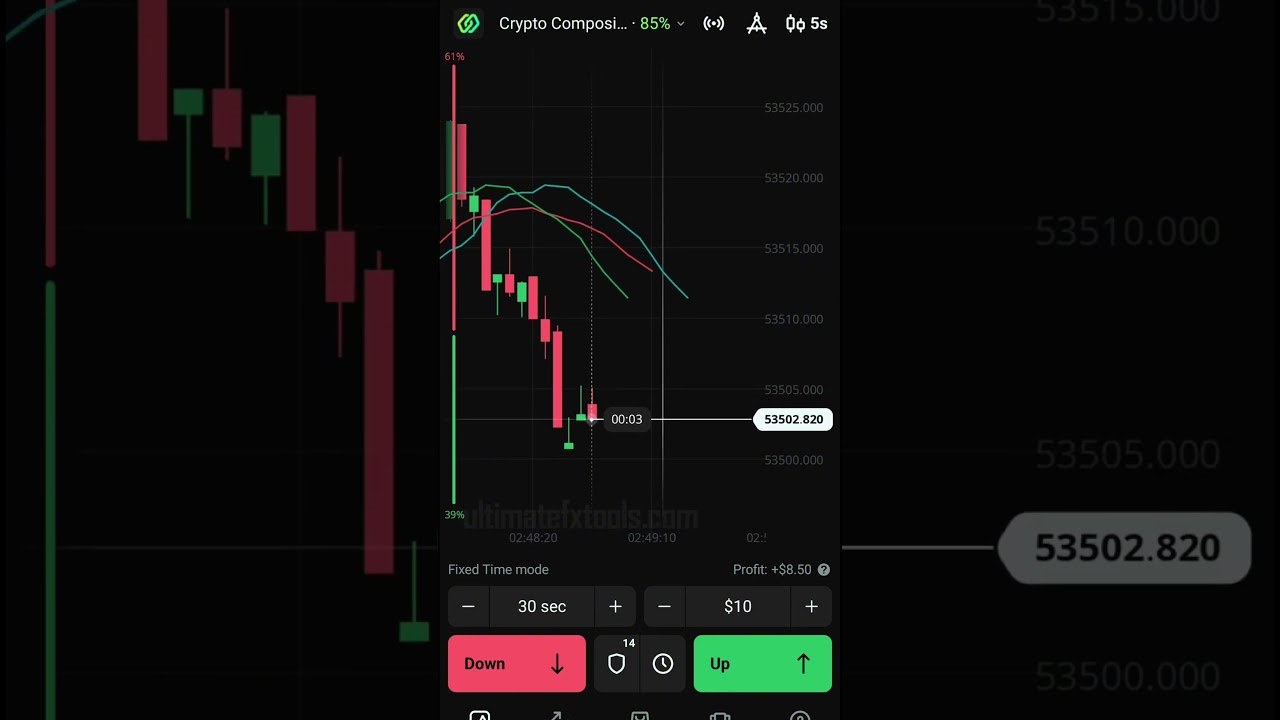
The session runs on the Olymp Trade mobile app, on 5-second candles with 30-second Fixed Time trades and a flat $10 stake, across three of the platform’s Composite indices at an 85% payout.
The Setup, Exactly as Shown
- Platform: Olymp Trade mobile app, Fixed Time mode
- Chart: candlesticks on the 5-second timeframe
- Trade duration: 30 seconds — not 5 seconds; the 5s in the top bar is the candle length
- Stake: flat $10, unchanged across both trades
- Payout: 85% on every asset shown (a $10 ticket returns $8.50)
- Assets: Asia Composite, Crypto Composite, Commodity Composite
- Indicator: Alligator, with custom periods (below)
Why These Are Not the Default Alligator Settings
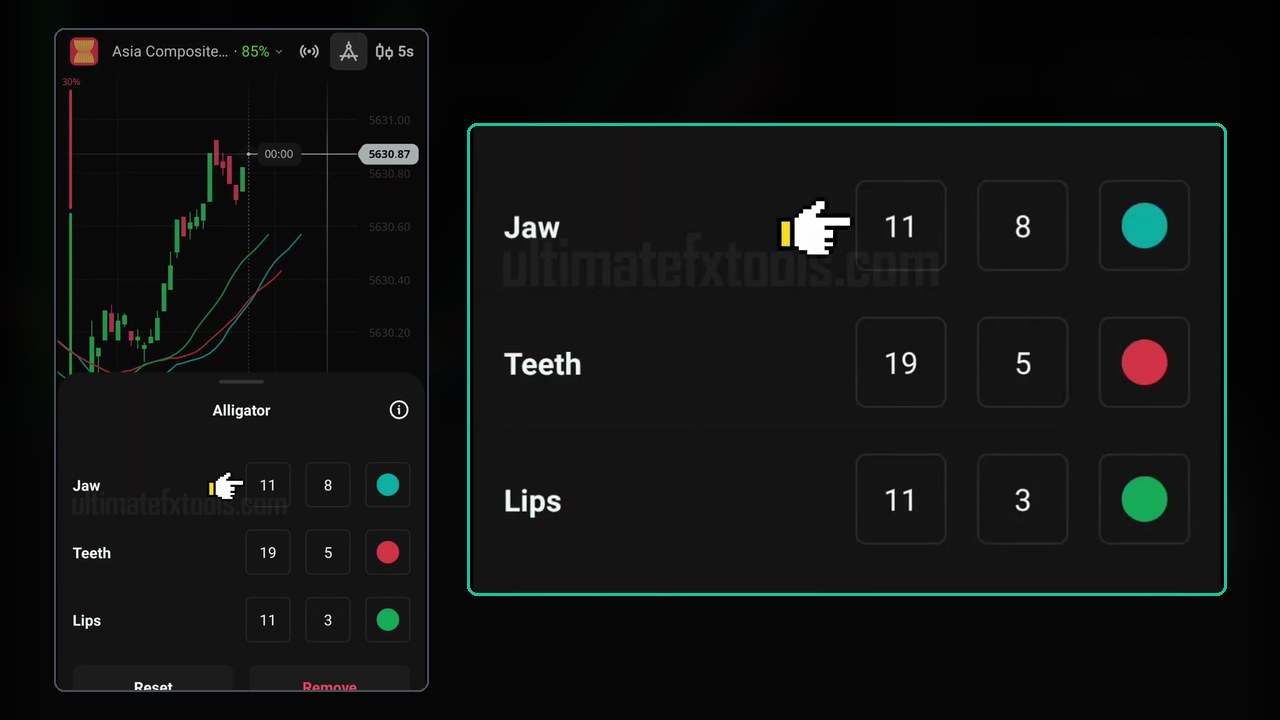
The standard Alligator that ships with almost every platform is Jaw 13/8, Teeth 8/5, Lips 5/3 — the Jaw is the slowest line, the Lips the fastest, and they fan out in that order. The panel in this clip shows something different:
- Jaw — period 11, shift 8 (teal)
- Teeth — period 19, shift 5 (red)
- Lips — period 11, shift 3 (green)
Two changes follow from that, and they are worth understanding before you copy the numbers:
- The red line is now the slowest of the three. At period 19 the Teeth lags both other lines instead of sitting between them. It stops behaving like the middle of a fan and starts behaving like a slow baseline — something the faster lines cross, rather than something that crosses them.
- Jaw and Lips share the same period. Both are set to 11, differing only in shift (8 versus 3). Two averages of the same length plotted at different offsets trace the same curve displaced sideways, which is why the teal and green lines in every frame run close and near-parallel.
So the setup is effectively one fast curve drawn twice at two offsets, plus one slow red baseline. That is a legitimate way to build a crossover system — it is just not what the Alligator was designed to be, and calling it “the Alligator” can mislead you into reading it the classic way (sleeping, eating, sated). Read it as a crossover instead.
The Signal: the Red Line Crossing
The clearest moment in the clip is marked by hand. On Crypto Composite, after a sharp drop, the trader circles the exact point where the red Teeth line crosses up through the teal Jaw line, and takes an Up trade on the next candle.
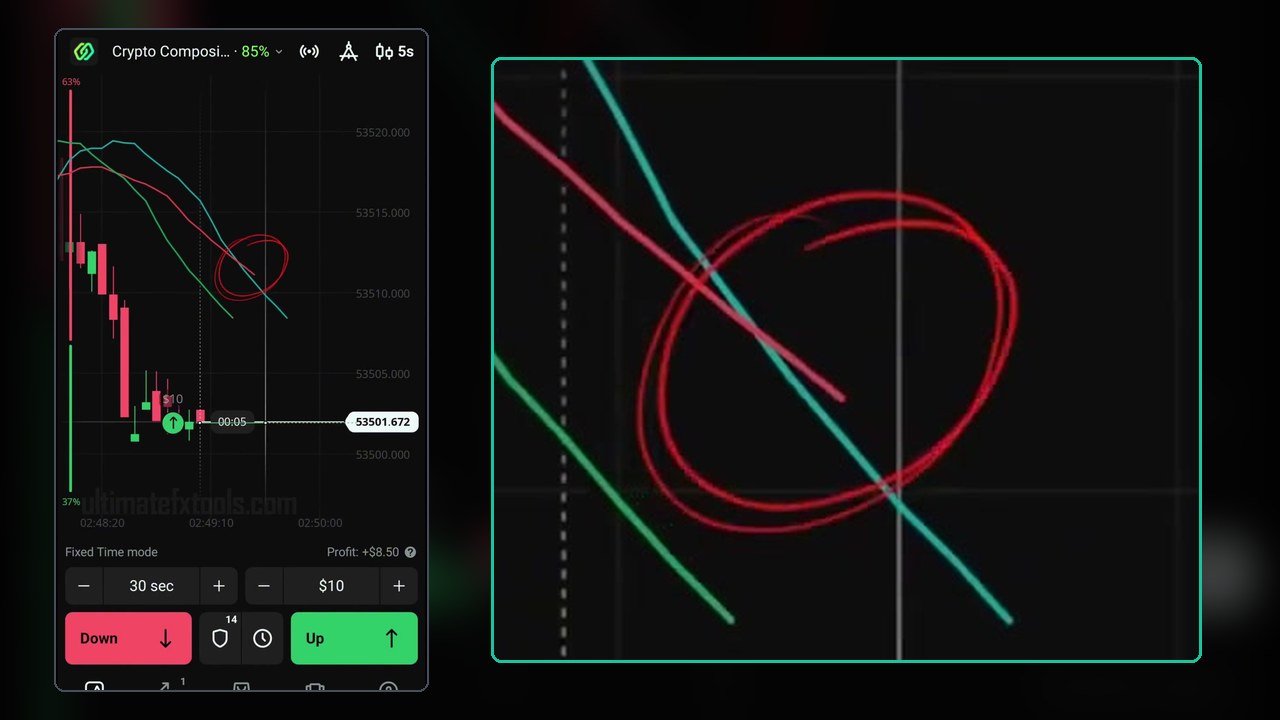
The mechanics behind that cross are worth spelling out, because it is not arbitrary. Both lines are falling hard. The teal Jaw, being the faster average here, falls more steeply than the slow red Teeth. When a fast line falls faster than a slow one and then crosses back above it, the selling has stopped accelerating — momentum is decaying. On a 30-second expiry, that decay is often enough.
That trade settled at +$8.50 — the full 85% on the $10 ticket. The result badge is visible on screen a few seconds later.
The Second Trade — and Where the Clip Stops
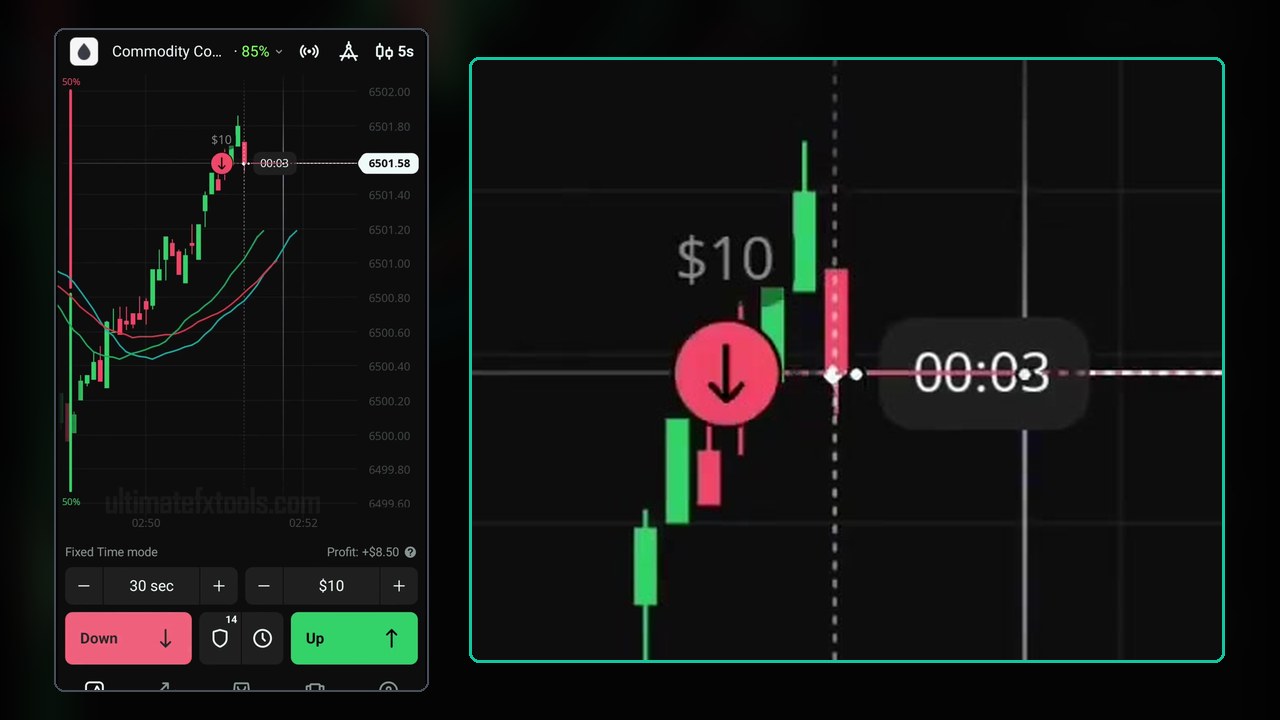
The second entry is a Down on Commodity Composite at 6501.58, taken after an extended push that has left price well above all three lines. When the clip ends the trade is still running — five seconds left, price at 6501.30, so it is ahead but not settled.
We are not going to tell you it won. It is unresolved on screen, and the honest description of this clip is one settled winner and one open trade, not two out of two.
What the Clip Does Not Tell You
The video has no voiceover and no description text, so some things simply are not stated. Being straight about which is which is the difference between a setup you can test and one you can only admire:
- There is no written entry rule. The circled cross is the clearest evidence of intent, and it points at a red-crosses-teal trigger. But the second entry is taken in a very different context — price extended above the lines rather than at a cross — which looks like a separate exhaustion read, not the same signal.
- No confirmation filter is shown. Nothing on screen says what would make a cross unacceptable — no trend filter, no minimum separation between the lines, no time-of-day rule.
- Two trades is not a sample. At an 85% payout, break-even sits near a 54% win rate. Nothing in a 46-second clip can tell you whether this setup clears that bar.
Turning It Into Something You Can Actually Test
The setup is specific enough to write down, which is more than most clips give you. A workable version:
- Trigger: the red Teeth (19/5) crosses the teal Jaw (11/8). Cross up = Up; cross down = Down.
- Filter: take the cross only when it happens after an extended directional run — the decaying-momentum case in the clip — and skip crosses that occur while all three lines are tangled flat, which on 5-second candles is most of the time.
- Expiry: 30 seconds, matching the clip. Six candles of 5 seconds each — long enough for the read to play out, short enough that it is still the same move.
- Stake: flat. The clip never changes off $10, and neither should a test.
- Record everything — every trigger, taken or skipped, with its outcome. Fifty entries on demo will tell you more than any clip can. If you would rather have that logging done for you, the PipGems signal verifier keeps a graded win-rate history per signal instead of leaving it to memory.
Watch the Clip
Forty-six seconds — the settings panel, the circled cross, and both entries:
Honest Weaknesses
- 5-second candles are mostly noise. At this speed the three lines spend long stretches tangled together, and a crossover system fires constantly in that state. The filter in step 2 above is not optional — without it this setup will hand you far more signals than it should.
- Composite indices are platform-specific instruments. Asia, Crypto and Commodity Composite are Olymp Trade’s own synthetic products. They are convenient because they price around the clock, but behaviour you measure on them does not automatically carry over to a live FX pair.
- The custom periods need justifying, not just copying. Jaw and Lips on the same period is an unusual choice. It may be deliberate and it may work — but the clip does not explain it, so treat the numbers as a starting point to test rather than a proven configuration.
- 30 seconds leaves no room to be wrong slowly. A late entry on a 30-second ticket is a materially different trade from the one the signal described.
Risk Management
- Fix your stake before the session and do not move it — no doubling after a loss.
- Cap the number of trades per session, and set a daily loss limit you honour without exception. Short expiries make it very easy to take twenty trades without noticing.
- Know your break-even: at 85%, you need better than 54% just to stand still.
- Test on a demo account until you have a real sample, not a good feeling.
Frequently Asked Questions
What Alligator settings are used in this Olymp Trade clip?
Jaw period 11 with shift 8 (teal), Teeth period 19 with shift 5 (red), and Lips period 11 with shift 3 (green). These are custom values, not the platform defaults of 13/8, 8/5 and 5/3.
Is the trade duration 5 seconds?
No. The 5s shown in the top bar is the candle timeframe. The trades are placed in Fixed Time mode with a 30-second duration and a flat $10 stake.
What does the red line crossing mean here?
Because Teeth is set to 19, the red line is the slowest of the three and acts as a baseline. The clip circles the moment the red Teeth line crosses up through the teal Jaw line after a sharp fall, and an Up trade is taken on the next candle.
What were the results in the video?
One trade settled for +$8.50 on Crypto Composite at the 85% payout. A second trade, a Down on Commodity Composite, was still open when the clip ended, so its outcome is not shown. Two trades is far too small a sample to judge the setup.
The Verdict
4.5 out of 5. What earns it: the clip shows its own settings panel, which almost no short trading video does, and it marks the trigger by hand instead of leaving you to guess. The setup is specific enough to write down as rules and take to a demo account — settings, timeframe, expiry, stake and payout are all legible on screen. That is a genuinely higher standard than the usual “watch this win” clip.
The missing half star is what is left unsaid: no stated rule, no confirmation filter, and a second entry that appears to follow different logic from the first. Take the configuration, write the rule yourself, and let a real sample decide whether it holds.
#OlympTrade #Alligator #FixedTime #5SecondChart #30SecondTrades #BinaryOptions #TradingStrategy #CrossoverStrategy
This content is for educational purposes only and is not financial advice. Trading involves substantial risk; you can lose some or all of your capital. No result is guaranteed and past results do not indicate future outcomes. Always practise responsible money management, limit your daily trades, and trade only what you can afford to lose.
More on this indicator: the Alligator strategy basics explain how the three lines are meant to be read, and the 30-second mobile version runs it on a longer expiry. For everything else on this platform, see the strategy library.