Quotex 5 Strategies to Boost Performance
Trading on the Quotex platform is fast, and that speed makes discipline more important than any single signal. Rather than chasing a "perfect" setup, most consistent traders lean on a small set of repeatable strategies and apply them the same way every session. Below are five practical approaches you can test on a demo account before risking real capital. None of them removes risk, and each one has market conditions where it struggles, so treat them as tools to structure your decisions, not shortcuts to a guaranteed outcome.
1. Trade With the Trend
The simplest edge many new traders overlook is trading in the direction of the dominant move. Use a moving average (for example a 20 or 50 period) to define the trend, then take entries that agree with it. When price sits above a rising average, you favour up trades; below a falling one, you favour down trades. Caveat: trend-following breaks down badly in sideways, ranging markets, where price whipsaws across the average and produces repeated false entries. Confirm there is a real trend before you apply it.
2. Support and Resistance Bounces
Mark the horizontal levels where price has repeatedly turned, then wait for it to return to one of those zones. A rejection candle at support can signal an up trade; a rejection at resistance can signal a down trade. This keeps you trading at points where other participants are already reacting. Caveat: levels do not hold forever. During strong news-driven moves, price cuts straight through support or resistance, so avoid these entries around scheduled economic releases.
3. Multiple Timeframe Confirmation
Before entering on a one or five minute chart, glance at a higher timeframe to see the broader context. When both agree, your entry has more behind it; when they conflict, it is usually better to skip the trade. This habit filters out a lot of low-quality setups. Caveat: waiting for alignment means fewer trades and some missed moves. If you force a trade just because you are impatient, you lose the benefit entirely.
4. Momentum With an Oscillator
Indicators such as RSI, Stochastic or DeMarker help you read momentum and spot overextended conditions. Some traders fade extremes; others wait for the oscillator to cross back from an extreme in the direction of the trend. Combined with the trend rule above, this can tighten your timing. Caveat: oscillators can stay "overbought" or "oversold" for a long time in a strong trend, so an extreme reading is not by itself a reason to trade against the move.
5. Stick to Fixed Expiry and Session Timing
Match your expiry time to the strategy and the chart you read, and trade during liquid sessions when spreads and behaviour are more consistent. Randomly switching expiry lengths mid-session makes it impossible to judge whether a strategy is actually working for you. Caveat: even a fixed routine underperforms during thin, illiquid hours or holiday periods, so keep a journal and review which sessions genuinely suit your approach.
Risk Management Comes First
No strategy matters if a few bad trades wipe out your balance. Risk only a small, fixed percentage of your account per trade, and decide in advance how many losses will end your session. Avoid martingale-style position doubling after a loss: it feels like a recovery plan but can escalate a normal losing streak into a full account loss very quickly. The goal is to survive long enough for a genuine edge to show, not to win back losses in one trade.
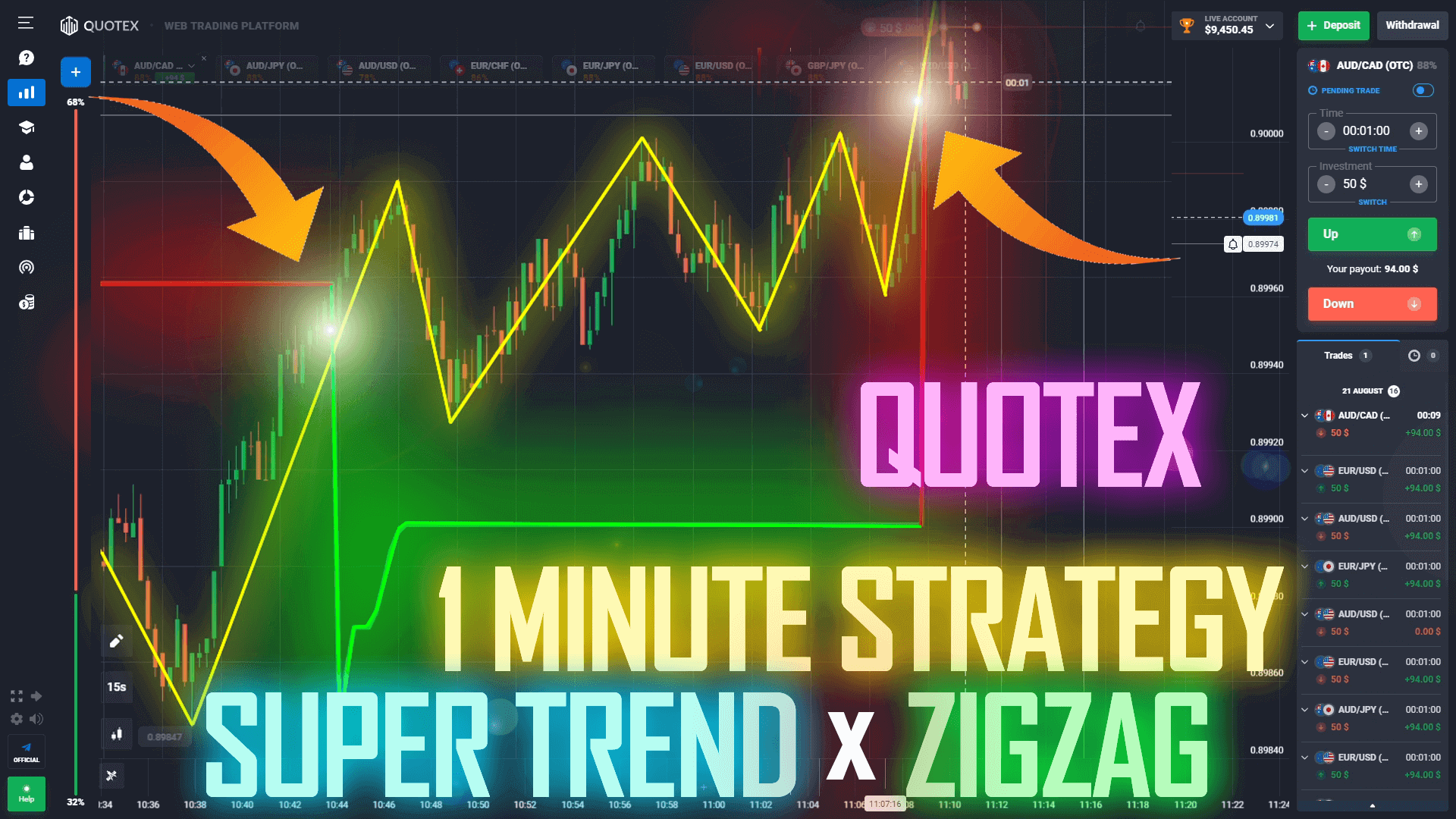
If you want ready-made indicators and strategy templates to test these ideas faster, the full UltimateFXTools library is available for a one-time $39 lifetime payment. You can also read our Quotex easy strategy and Quotex 1 minute strategy for step-by-step walkthroughs.
Frequently Asked Questions
Will these strategies boost my win rate?
Honestly, it depends, and there is no guarantee. These are frameworks for making more consistent decisions, not formulas that produce a fixed result. Two traders can use the same strategy and get very different outcomes based on discipline, timing and risk control. Test each idea on a demo account and judge it on your own records.
Which strategy is best for beginners?
Trading with the trend is usually the easiest to learn because the rules are simple and the context is visible on the chart. Start with one strategy, master it, and only add another once you can follow the first one without second-guessing every entry.
Do I need paid indicators to trade on Quotex?
No. The Quotex platform includes moving averages, RSI, support and resistance tools and more, which are enough to apply every strategy above. Paid indicators can save setup time and add alerts, but they are a convenience, not a requirement, and they do not change the underlying risk.
This content is for educational purposes only and is not financial advice. Trading involves substantial risk; you can lose some or all of your capital. No result is guaranteed and past performance does not indicate future results. Trade only what you can afford to lose.