"EMA + SMA + Weis Waves"
"Combination of Indicators"
"Quick Reversal Method"
Quick Reversals with Moving Averages and Weis Waves
Having a reliable and efficient strategy can make all the difference. Today, we'll explore a robust method using Exponential Moving Averages (EMA), Simple Moving Averages (SMA), and the Weis Waves Volume Oscillator to identify quick reversals and trend behaviors. This strategy is designed for a trading duration of just 5 seconds, making it ideal for traders who thrive on rapid decision-making.
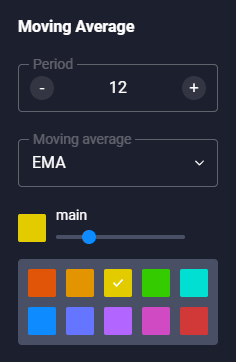
1. Exponential Moving Average (EMA)
- Period: 12
- Line Color: Green
The EMA is a powerful tool for capturing short-term price movements. By setting the period to 12, you'll gain insight into recent market trends, with the green line serving as a visual guide for potential bullish movements.
2. Simple Moving Average (SMA)
- Period: 24
- Line Color: Red
The SMA, with a period of 24, helps smooth out price data, providing a clearer view of longer-term trends. The red line acts as a benchmark against which short-term movements (indicated by the EMA) can be measured.
3. Weis Waves Volume Oscillator
- Length: 4
- Opacity: 100
This oscillator measures volume waves to capture momentum shifts. Setting the length to 4 ensures sensitivity to swift changes, while full opacity enhances visibility.
Executing the Strategy
The core of this strategy revolves around the interaction between the EMA and SMA lines, along with the momentum indicated by Weis Waves:
Uptrend Signal: When the green EMA line crosses above the red SMA line, it suggests an upward price movement. Confirm this signal by ensuring that the Weis Waves are also showing an upward momentum.
Downtrend Signal: Conversely, if the red SMA line crosses above the green EMA line, it indicates a potential downturn. For added confirmation, check that the Weis Waves are pointing downward.
Monitoring for Momentum
Ensuring that the Weis Waves are in a strong momentum phase—either upward or downward—is crucial for validating the crossover signals. This additional layer of analysis helps in avoiding false signals and enhances the accuracy of your trades.
Conclusion
This strategy leverages the strengths of both moving averages and volume oscillators to provide a comprehensive view of market trends. By focusing on crossovers and validating with momentum indicators, traders can better anticipate quick reversals and make informed decisions in a matter of seconds. Remember, practice and real-time analysis are key to mastering this technique effectively. Happy trading!