Pocket Option 15-Second Two-WMA Crossover
Pocket Option offers a 15-second trade duration that lets you open and close positions inside a very short window. That speed leaves almost no room for a trade to recover once it moves against you, so the method has to be simple to read and honest about its limits. This page walks through a two Weighted Moving Average (WMA) crossover, filtered with the DeMarker oscillator, and explains what the crossover can and cannot tell you.

What a Two-WMA Crossover Actually Marks
A moving-average crossover is a lagging trend signal. When a faster average crosses a slower one, it is confirming that momentum has already shifted direction over the last several candles. The cross does not predict a move; it reports one that has begun. A lot of material treats a crossover as a green light, but it is closer to a rear-view mirror.
Weighted Moving Averages react faster than Simple Moving Averages because they weight recent prices more heavily, so the cross fires a little earlier. But "earlier" is relative — a WMA still lags live price, and on a 15-second chart that lag matters. The main weakness is the one every crossover carries: in a ranging market the two lines braid together and produce repeated false crosses, or whipsaws, with no trend to ride. That is why the crossover needs a filter and strict risk rules, not blind entries.
Weighted Moving Average Settings
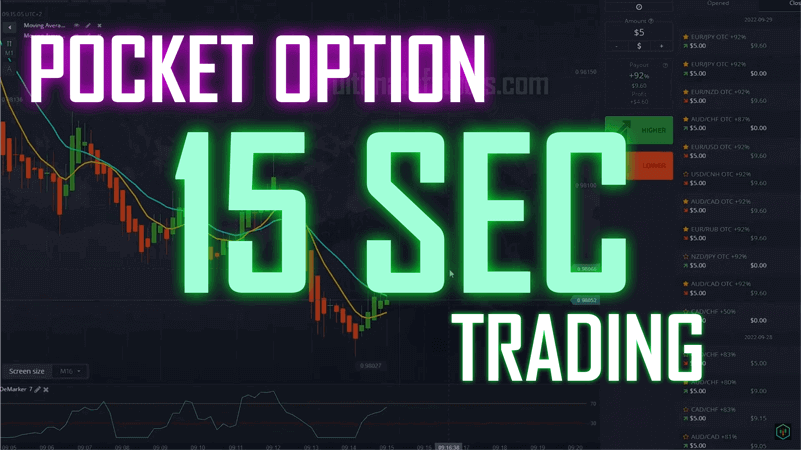
Add two Weighted Moving Averages to your chart. Set the first with a period of 12 and give it a colour you can spot easily; set the second with a period of 23 in a contrasting colour. The 12 line is your fast average, the 23 your slow one. The signal event is simply when the two weighted average lines cross each other — that is the moment you start looking for a trade, not the moment you fire one.

Adding the DeMarker Filter
A crossover says nothing about whether price is stretched, so pair it with the DeMarker oscillator set to a period of 7 with levels at 70 and 30. A bullish cross is more credible when DeMarker is turning up from the lower area rather than pinned near the 70 overbought line, and the reverse for a bearish cross. Treat the filter as a veto whose job is to talk you out of weak setups.

Entry Logic
Keep the rules mechanical so you can apply them calmly inside a 15-second window:
- Higher / Call: the fast WMA (12) crosses above the slow WMA (23), and DeMarker is rising out of the lower region rather than sitting at the 70 line.
- Lower / Put: the fast WMA (12) crosses below the slow WMA (23), and DeMarker is falling from the upper region rather than sitting at the 30 line.
- Stand aside: the two averages are flat and intertwined, the cross is shallow, or DeMarker disagrees with its direction. A sideways chart is where the crossover whipsaws, so no trade is the correct trade.
Let each candle finish before you act on a cross, and trade a few liquid pairs you know rather than hunting signals across the whole watchlist.
When the Crossover Fails
Two situations break this method. The first is a ranging market: with no trend, the 12 and 23 lines cross repeatedly and every cross looks like a signal, which is how small losses stack up on short expiries. The second is lag at a turning point: because the cross confirms a move already underway, entering right at the crossover can put you in just as the push is ending. Neither flaw means abandoning the tool — they mean demanding a clean trend, respecting the DeMarker veto, and sizing every trade as if it can lose, because some will.
For more on moving-average methods, compare this with the IQ Option weighted moving average strategy and the Pocket Option moving averages with DeMarker guide. If you prefer a two-line EMA approach, see the two-EMA Olymp Trade setup, and for the short-duration context there is our 15-second Pocket Option strategy.
FAQ
Is a two-WMA crossover a leading or lagging signal?
It is lagging. The cross confirms a move that has already started over the previous candles, so it describes momentum rather than predicting it. That is why the DeMarker filter and a genuine trend matter — they help you avoid acting on a cross that has already run its course.
Why does the crossover give so many false signals?
False crosses, or whipsaws, happen when the market is ranging. With no clear trend the fast and slow averages keep braiding together, so each small swing triggers a cross. Standing aside during flat, sideways conditions removes most of these weak setups.
Do I need the paid indicators to trade this?
No. The two Weighted Moving Averages and the DeMarker oscillator are standard tools built into most platforms, so you can practise this method on a demo account for free. If you later want the wider indicator library, that is what the $39 lifetime plan covers, but it is not required for this strategy.
This content is for educational purposes only. Trading involves risk. Past results do not guarantee future outcomes. Always practice responsible money management and limit your daily trades to avoid large losses.