Best 5 Trading Strategies for Quotex Using Free Indicators
The Quotex trading platform ships with a solid set of built-in indicators, so you do not need any paid add-ons to start building a repeatable method. What separates a plan from a guess is choosing one or two indicators that suit your style, learning how they behave, and testing them on a demo account before you risk real money. Below are five popular approaches that use only free tools on the platform. Each one works well in some conditions and poorly in others, so treat them as starting points to study rather than shortcuts.
None of these strategies wins every trade, and no indicator can predict the future. Markets shift between trending and ranging phases, and news events can invalidate a clean setup in seconds. The goal is to trade setups you understand, keep your position sizes small, and accept that losing trades are a normal part of the process.
1. Moving Average Crossover
Plot two moving averages — one short-term and one long-term. When the short average crosses above the long one, it points to upward momentum; a cross below points to downward momentum. It is simple and helps you stay on the side of a clear trend. Caveat: moving averages lag price, so in choppy, sideways markets they produce frequent false crosses. Crossovers work best when a market is genuinely trending.
2. MACD Momentum
The Moving Average Convergence Divergence indicator compares two moving averages to highlight shifts in momentum. A cross of the MACD line above its signal line suggests building bullish momentum, and a cross below suggests bearish momentum. Caveat: like all momentum tools, MACD can whipsaw during low-volatility ranges and lags at sharp reversals, so it pairs best with a read of the wider trend.
3. Candlestick Patterns
Candlestick patterns such as bullish or bearish engulfing candles describe how buyers and sellers fought over a period, offering clues about the next move. Learning to read them helps you time entries and exits around support and resistance. Caveat: a single candle is only a hint, not a promise. Patterns are far more reliable when confirmed by trend context or another indicator, and they fail regularly when traded in isolation.
4. OTC Market Approach
Over-the-counter (OTC) assets are available on Quotex when regular markets are closed, including weekends. Reading market sentiment and using volume-style indicators can help you judge the strength behind a move. Caveat: OTC price action is generated differently from live exchange markets and can behave erratically. Many traders find OTC harder to read, so keep stakes especially small here.
5. One-Minute Scalping
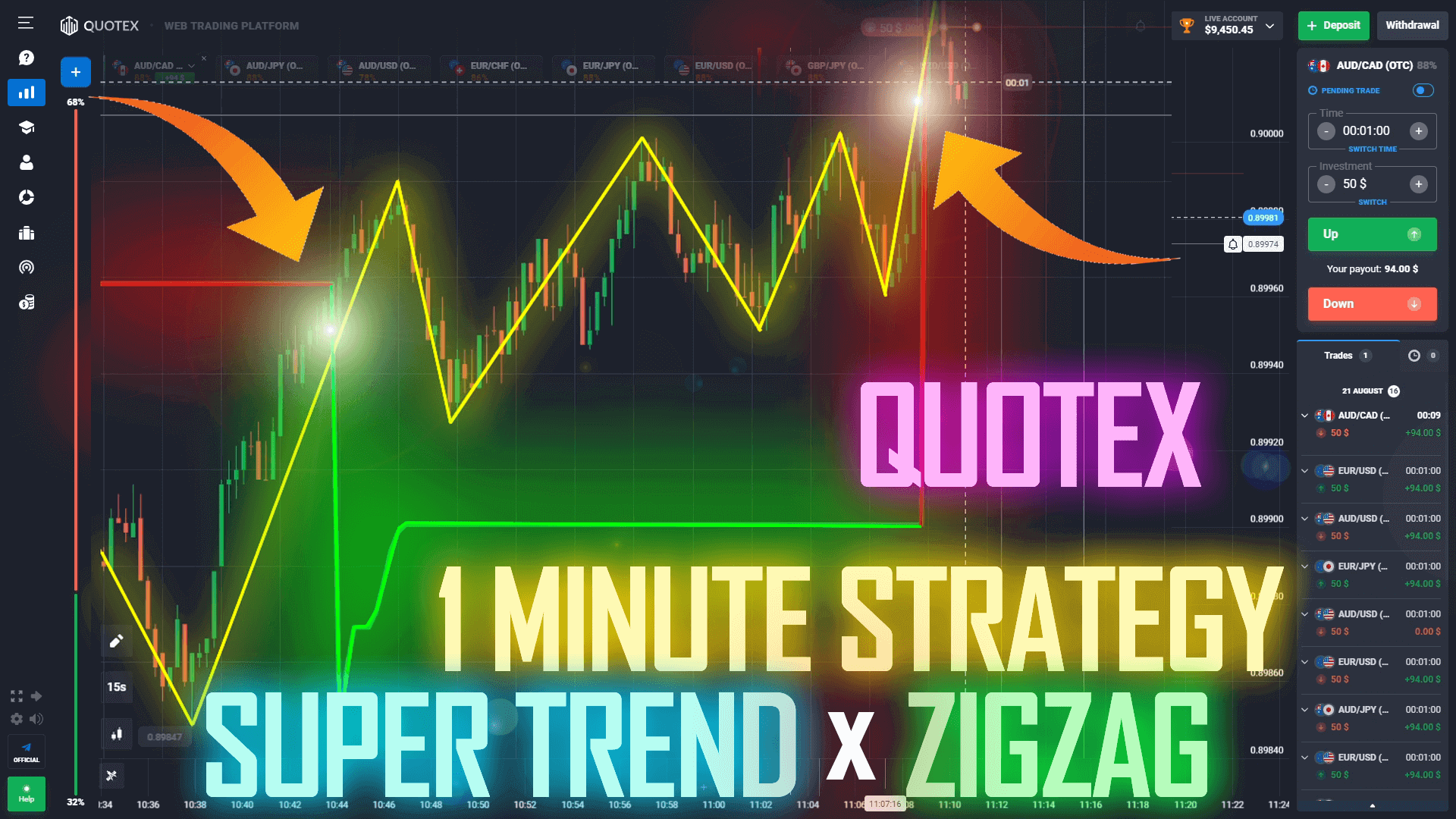
For fast-paced trading, a one-minute approach uses tools like the Relative Strength Index (RSI) or stochastic oscillators to flag overbought and oversold conditions inside a tight timeframe. Caveat: short timeframes are noisy, spreads and timing matter more, and rapid decisions raise the risk of overtrading. This style demands the most discipline and is not a good place for beginners to start.
Risk Management Matters Most
No strategy survives poor risk control. Decide in advance how much of your account you are willing to risk on any single trade — many traders cap this at a small percentage — and never chase losses. Avoid the martingale method of doubling your stake after a loss: it can wipe out an account during a normal losing streak and is one of the fastest ways to blow up a balance. Keep a simple journal, review your trades, and stick to setups you have actually tested. If you want ready-made indicators and strategy files to study, our full toolkit is available for a one-time $39 lifetime payment.
If you are still learning the platform, these companion guides are worth a look: the Quotex easy strategy walks through a beginner-friendly setup, while the Quotex 1 minute strategy digs deeper into short-timeframe trading.
Frequently Asked Questions
Will these strategies guarantee wins?
No. There is no strategy or indicator that guarantees winning trades. Every approach here has market conditions where it fails, and losses are an unavoidable part of trading. The aim is to trade setups you understand with disciplined risk control, not to chase a system that always wins.
Do I need to pay for indicators on Quotex?
No. All five strategies above rely on indicators already built into the Quotex platform, so you can practise them for free. Paid tools can save time or add convenience, but they are not required to learn these methods.
Should I test on a demo account first?
Yes. A demo account lets you learn how each indicator behaves and refine your entries and exits without risking real money. Only move to a live account once you can follow your plan consistently, and start with amounts you can afford to lose.
This content is for educational purposes only and is not financial advice. Trading involves substantial risk; you can lose some or all of your capital. No result is guaranteed and past performance does not indicate future results. Trade only what you can afford to lose.