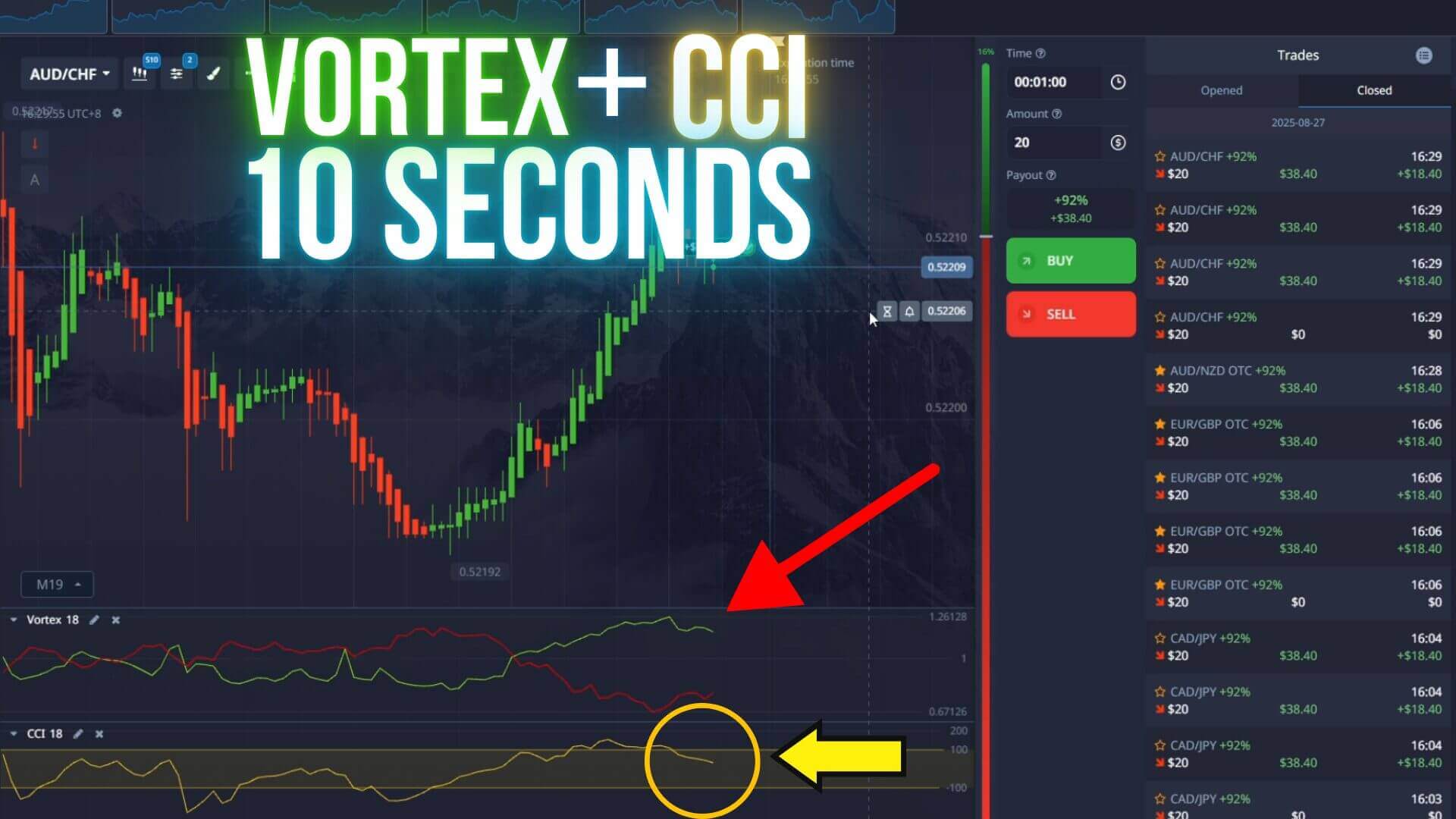
"Vortex + CCI"
"10 Second Pocket Option"
"Pocket Option Strategy"
Pocket Option Strategy Using Vortex + CCI
This post explains a practical, repeatable Pocket Option strategy that uses the Vortex Indicator and the Commodity Channel Index (CCI) set to period 18. It's geared for quick 1‑minute trades (with a 10‑second Heiken Ashi observation technique described below). We used a martingale recovery when a trade loses; I include clear money‑management rules and risk controls so you can practice safely and consistently.
Core idea of the 10 Second Strategy
- Use two indicators:
- Vortex Indicator (default two lines -18 period): look for when the two vortex lines are widely separated, indicating a strong trend.
- CCI (period 18): use +100 and −100 as key resistance/support thresholds. A move from below −100 upward signals potential bullish reversal entry; a move from above +100 downward signals potential bearish reversal entry.
- Wait for candle confirmation (Heiken Ashi green/red reversal bar) aligned with CCI direction and vortex separation before entering.
- If a trade loses, apply a controlled martingale sequence (small, predefined steps) only if safety rules are met.
Settings and chart setup
- Timeframe: 10 Second
- Indicators:
- Vortex Indicator: standard settings. Watch distance between the two lines (large separation = strong trend).
- CCI: period = 18. Key levels: +100 (resistance), −100 (support).
- Candles: Heiken Ashi for visual momentum; you mentioned observing 10‑second Heiken Ashi observations — that means glance at 6 ten‑second slices inside each 1‑minute bar to see momentum developing (optional, higher attention).
- Asset selection: high‑liquidity pairs (major forex, or popular crypto/indices) for tighter spreads and clearer moves.
- Trading window: avoid major news events; prefer stable sessions with good liquidity.
Entry rules (bullish)
- Vortex lines are distant (uptrend indicated by positive vortex line above negative). Ideally a clear separation.
- CCI has been at/near −100 (showing it reached negative support) and has started to turn upward.
- A bullish Heiken Ashi reversal bar (green) appears on the 1‑minute chart or you see consecutive short‑term upward momentum within the minute (10s checks).
- CCI slope is upward and crossing from below −100 toward center.
- Enter a CALL (up) for the 1‑minute trade.
Entry rules (bearish)
- Vortex lines are distant (downtrend indicated by negative vortex line above positive or vice versa depending on your platform definition).
- CCI has been at/near +100 (resistance) and begins to point downward.
- A bearish Heiken Ashi reversal bar (red) appears.
- CCI slope is downward and crossing from above +100 toward center.
- Enter a PUT (down) for the 1‑minute trade.
Exit / target
- For one‑minute trades, the trade exits automatically at expiry.
- For other instruments (CFD), use a tight take profit (e.g., 1:0.5 to 1:1 RR on scalps) and a hard stop.
Martingale recovery (controlled) Martingale increases stakes after loss to recover previous loss + profit. Use this only if you accept the risks. Implement strict rules:
- Max martingale steps: 2–3 steps (no more). Example: base stake $1 → if loss → step 1 stake $2.5 → if loss → step 2 stake $6.5 (numbers illustrative; pick your own multiplier).
- Maximum drawdown per session: decide a fixed dollar/percentage stop (e.g., stop after 3 consecutive losses or 5% of account per session).
- Never exceed a pre‑set portion of account on any single sequence (e.g., max 2–5% of balance exposed).
- If margin/available funds insufficient, stop martingale sequence automatically.
- Prefer fixed sized increments or a conservative multiplier (1.8–2.5), not huge doubling.
Money management & session rules
- Risk per base trade: 0.5–2% of total account balance.
- Max daily loss limit: e.g., 5% of account. If hit, stop trading for the day.
- Max daily profit target: set a realistic target (e.g., 2–4% of account) and stop when reached.
- Demo practice: run this strategy for at least 1000 demo trades or 3–4 weeks of consistent testing before using real funds.
- Keep a trade log: time, asset, entry reason, indicators reading, result, stake, and notes. Review weekly.
Common setups and examples (descriptive)
- Example 1 (bullish reversal): Vortex lines are separated, downward trend cooling; CCI hit −100 and turned up; a green Heiken Ashi candle forms. Trade CALL for 1 minute. If win, record and continue. If loss, use martingale step 1 if rules allow.
- Example 2 (trend continuation filtered by CCI): Vortex strongly trending down. CCI rises close to +100 then rolls down and forms downward Heiken Ashi. Trade PUT for 1 minute.
- If Vortex lines are close together or CCI is flat near zero, skip — low probability.
Risk notes and limitations (must read)
- No method guarantees 70–80% returns consistently. Claims of such high win rates are often exaggerated.
- Martingale can produce large drawdowns and wipe accounts fast in streaks of losses.
- 1‑minute trading is effectively scalping — noise and spreads matter. Slippage and execution speed on Pocket Option can change results.
- Backtest and forward demo test the combination of Vortex(18)+CCI(18) under different market conditions.
Checklist before each trade
- Are vortex lines clearly separated? Y/N
- Is CCI near a key level (±100) and turning? Y/N
- Did a Heiken Ashi reversal bar appear? Y/N
- Is there any scheduled news in the next 15 minutes? N/Y
- Stake size vs account rules OK? Y/N If any answer is NO, skip the trade.
#PocketOption #TradingStrategy #VortexIndicator #CCI #CCI18 #VortexCCI #Martingale #1MinuteTrading #Scalping #HeikenAshi #MoneyManagement #RiskManagement #TradingPlan #ForexScalping #PocketOptionsStrategy
Closing This method can help you structure quick trades using Vortex + CCI (period 18) and an optional martingale recovery plan. The key is disciplined money management, strict stop rules, demo testing, and realistic expectations. If you want, I can:
- Produce a printable checklist/one‑page cheat sheet.
- Create a sample martingale stake calculator in Excel or Google Sheets.
- Build a demo trade log template (CSV) you can paste into a spreadsheet.
Which follow‑up would you like?