What Makes Super Trend + Bollinger Bands Powerful?
The combination of Super Trend and Bollinger Bands creates one of the most reliable setups for binary options trading on Pocket Option. Each indicator brings a distinct edge: Super Trend defines the dominant direction of price while Bollinger Bands reveal when price is extended or compressed, giving you ideal entry zones rather than random signal chasing.
The Super Trend indicator is an ATR-based trend following tool that plots a line above or below price. When the Super Trend line sits below price and turns green, it signals bullish momentum. When it flips above price and turns red, the trend has shifted bearish. It is clean, responsive, and easy to read at a glance — which is exactly what you need in fast-moving binary trades.
Bollinger Bands consist of three lines: a middle band (typically a 20-period SMA) and an upper and lower band set two standard deviations away. When price touches or pushes outside the upper or lower band, it is often in an overextended state. When price returns inside the bands — especially after bouncing off an outer band — it signals a mean reversion that can be traded profitably.
When you combine these two tools, you get a trend filter (Super Trend) and a precision entry trigger (Bollinger Bands band touches), creating a high-quality signal setup that reduces false entries significantly.
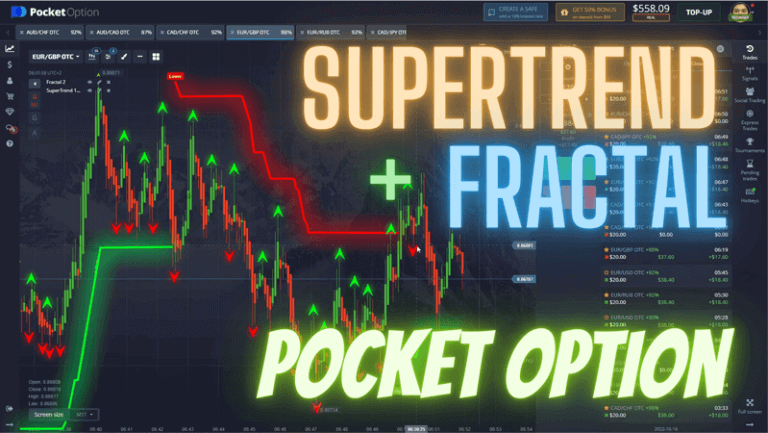
Indicator Settings for Pocket Option
Apply both indicators directly on the Pocket Option chart platform. Use 1-minute candlesticks for the most active signal generation, though the 5-minute chart gives slightly fewer but higher-quality setups.
Super Trend Settings
- ATR Period: 7
- ATR Multiplier: 3.0
- Bullish Color: Green
- Bearish Color: Red
A multiplier of 3.0 keeps the Super Trend from flipping too frequently on small retracements, which helps you stay in alignment with the prevailing trend direction rather than being shaken out by normal price oscillations.
Bollinger Bands Settings
- Period: 20
- Standard Deviations: 2
- Source: Close
Standard 20/2 Bollinger Band settings work well across all timeframes. The key is watching for price to touch or close outside the bands while Super Trend confirms the direction. That combination is your entry signal.
Entry Rules — When to Buy and Sell
The entry method is built around trend confirmation + band reversal. You are trading with the Super Trend direction and waiting for Bollinger Band extremes to give you a better-than-average entry price.
Buy (Call) Trade Setup
- Super Trend line is below price and green — confirming bullish trend
- Price touches or closes outside the lower Bollinger Band — price is oversold relative to recent movement
- The next candle opens back inside the bands — showing the pullback is complete
- Enter a Call trade on the candle that closes back inside the lower band
- Use a 1-minute or 2-minute expiry
Sell (Put) Trade Setup
- Super Trend line is above price and red — confirming bearish trend
- Price touches or closes outside the upper Bollinger Band — price is overbought relative to recent movement
- The next candle opens back inside the bands — showing the push higher is exhausted
- Enter a Put trade on the candle that closes back inside the upper band
- Use a 1-minute or 2-minute expiry
Do not take trades where the Bollinger Band touch occurs against the Super Trend direction. If Super Trend is green (bullish) and price touches the upper band, that is not a valid sell signal — it is price running in the trend direction and should be ignored or watched for a potential breakout continuation.
Timeframe and Trade Duration
The most consistent results with this setup come from the 1-minute chart with 1-minute expiry. This is because the Super Trend on a 1-minute chart reacts to intraday momentum quickly, and Bollinger Band touches on 1-minute are common enough to generate multiple trades per session.
For traders who prefer fewer but stronger setups, use the 5-minute chart with a 5-minute expiry. The signals will be less frequent but the trend context is cleaner and band touches are more meaningful. The tradeoff is fewer trading opportunities per session.
Avoid very short expiries (15 seconds, 30 seconds) with this strategy. Both indicators need at least a full 1-minute candle to develop a reliable signal — sub-minute expiries introduce too much randomness.
Risk Management
Even with a high-quality setup, sound risk management is the foundation of long-term profitability on Pocket Option. Apply these rules without exception:
- Never risk more than 3% of your account balance per trade. A single bad streak can wipe out hours of gains if position sizes are too large. Keep each trade small relative to your total balance.
- Stop after 3 consecutive losses. Three losses in a row often signal that market conditions have changed or you are trading during low-quality periods. Close the platform, review your trades, and come back fresh.
- Only trade during trending conditions. Both Super Trend and Bollinger Bands perform poorly in tight ranging markets. If the Bollinger Bands are extremely narrow and price is not moving, the market is in consolidation. Wait for a breakout and trend establishment before entering.
- Avoid the first and last 15 minutes of major sessions. The open and close of the London and New York sessions often produce erratic spikes that look like signals but are actually just order flow volatility. The cleaner trend signals form once sessions are fully underway.
- Use a demo account to practice first. If you are new to this setup, spend at least two weeks practicing on a Pocket Option demo account. Track every signal and outcome before committing real funds. This builds pattern recognition and confidence without financial risk.
The Super Trend + Bollinger Bands combination is a proven and practical approach to binary options on Pocket Option. The strategy works best when you trade with the trend, enter on band extremes, and manage risk carefully — giving you a repeatable edge across multiple sessions.