Real Live Session on Quotex — Powered by PipGems
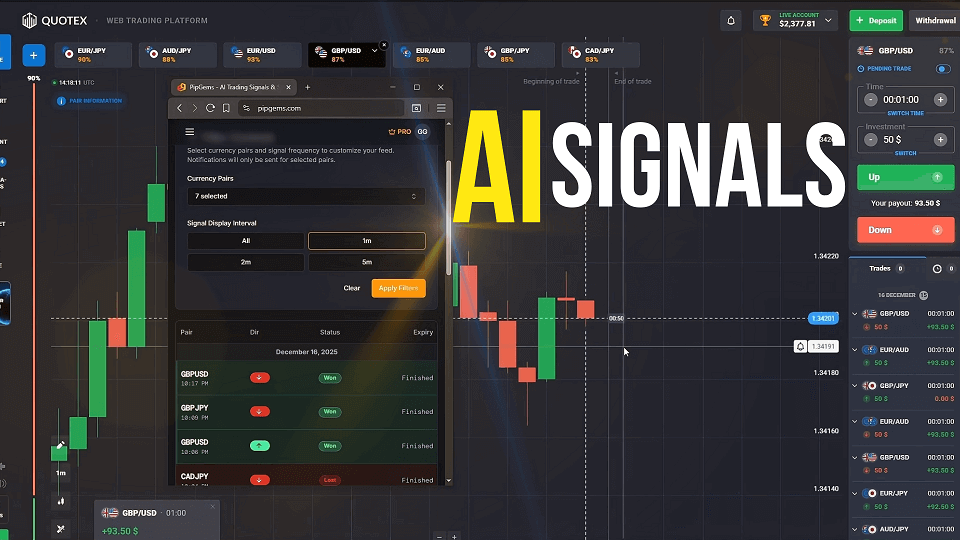
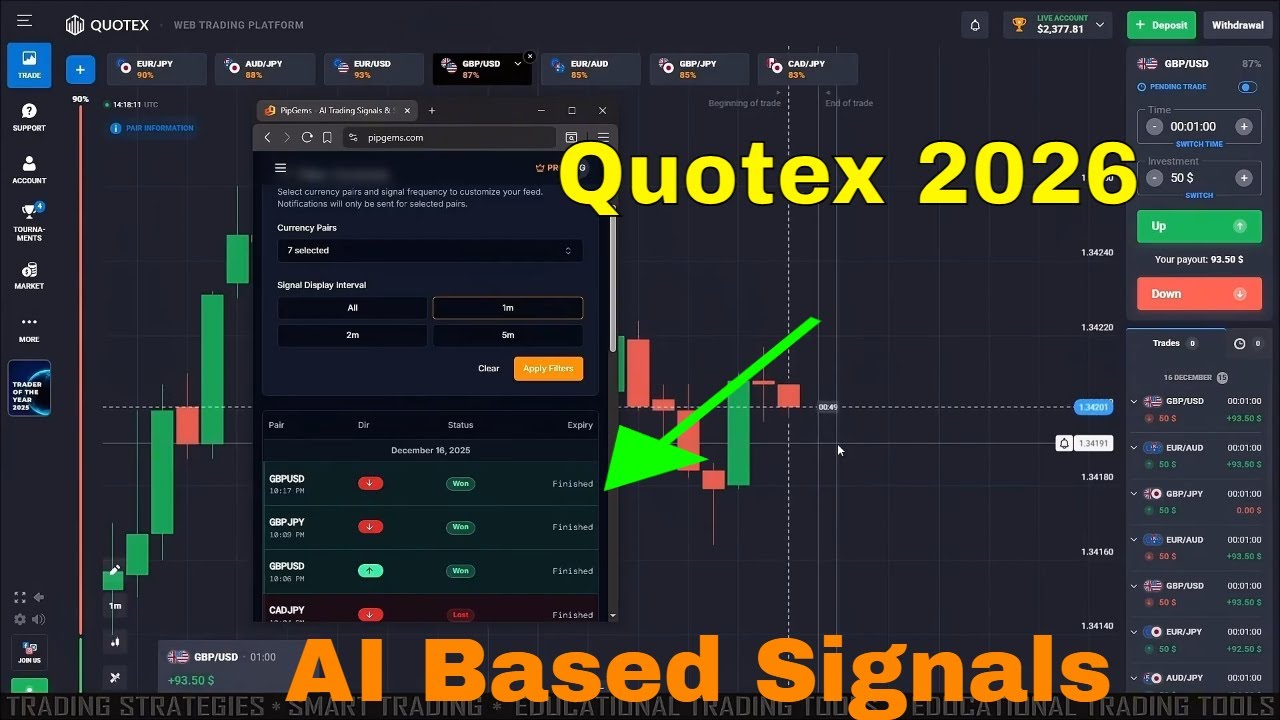
This is not a backtested strategy. This is a real live session on Quotex PRO using PipGems AI signals — the app already filtered down to 7 high-performing pairs on a 1-minute interval. Trade size was fixed at $50 per trade.
No manual chart analysis. No extra indicators. Just the signal, the pair, the direction — and fast execution. Here's the complete walkthrough of every trade from the session.
What Is the PipGems 1-Minute Strategy?
The PipGems 1-minute strategy is built around one core idea: use AI signals for directional bias and execute immediately. There is no manual analysis involved on your side. PipGems does the heavy lifting — it filters pairs by performance, scans market conditions, and fires a directional signal (UP or DOWN) in real time.
Your job as the trader is simple:
- Open Quotex on the same pair PipGems flagged
- Set the expiry to 1 minute
- Enter the trade within 5–10 seconds of the signal
- Log the result and repeat
There is no guessing, no second-guessing the chart, and no indicator juggling. The signal is the strategy. Timing is the only variable you control — and as you'll see below, that matters a lot on 1-minute expiry.
Trade Walkthrough — 4 Trades, Live Results
Here are all 4 trades from this session in order. Each card shows the pair, direction, outcome, and key context.
The Lesson: Late Entry = Higher Risk
The one loss this session was not a bad signal — it was a bad entry. EUR/USD was showing a valid DOWN signal, but the execution was delayed by roughly 8–10 seconds. On a 1-minute expiry, that window can be the difference between catching the move and getting caught in a reversal wick.
On 1-minute trades, you have a maximum of 5–7 seconds after a PipGems signal fires to enter. Any later and the risk profile changes significantly. The first candle sets the direction — if you miss it, you're chasing.
The signal was right. EUR/USD did push down. But the price had already moved a significant portion of its 1-minute range by the time the trade was entered late. This compressed the profit window and exposed the position to a spike reversal near expiry.
Before each session, open Quotex on your most active PipGems pair with the trade amount already set. When the signal fires, you're one click away. Reducing friction = faster execution = fewer late entries.
How to Run This Strategy — 5 Steps
This is the exact process used in the session above. Follow it in order for every trade:
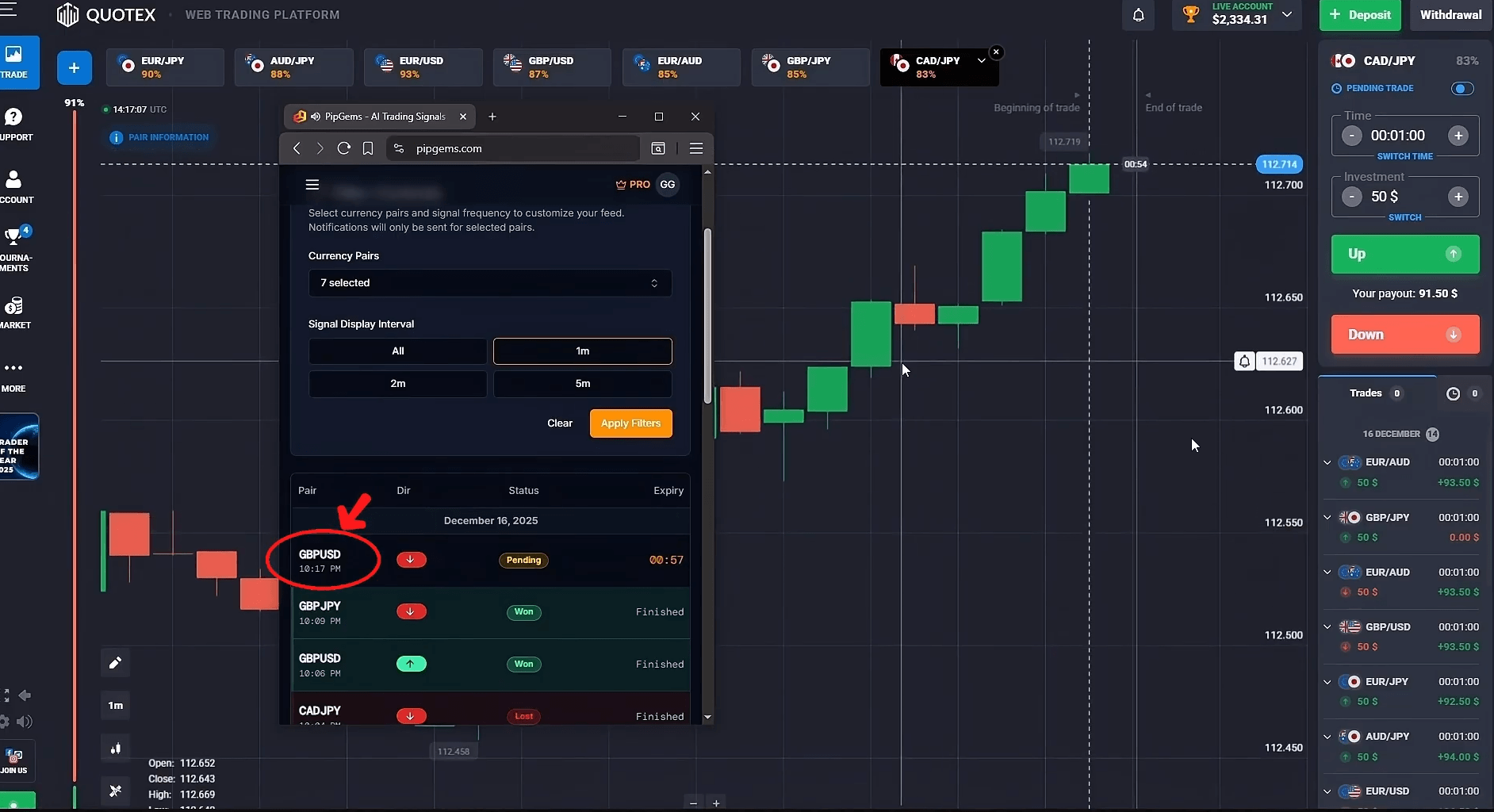
Open PipGems and filter by 1-minute interval. Select 5–7 high-performing major and cross pairs. Avoid OTC instruments and exotic pairs. Recommended: GBP/USD, EUR/USD, EUR/JPY, GBP/JPY.
Match your Quotex chart to whichever pair is active on PipGems. Set expiry to 1 minute. Pre-load your trade amount ($50 or whatever your session stake is) so you're ready the moment the signal fires.
Confirm pair, direction, expiry (1 minute), and amount. Use a fixed stake per trade — don't increase size after a loss. Consistent sizing is how you protect your account during losing streaks.
The moment PipGems fires the signal, enter the trade. You have a 5–7 second window before the trade becomes a late entry. Sound notifications on PipGems help — keep them enabled during live sessions.
Log the outcome (win/loss), note if entry was on time or late, and move to the next signal. Aim for 4–6 trades per session max. Quality execution over quantity.
Why Filter High-Performing Pairs?
Not all forex pairs behave the same on 1-minute charts. Exotic pairs tend to have wider spreads, lower liquidity, and more erratic price action — all of which make 1-minute trading unreliable. PipGems is designed to filter this noise out automatically, but your pair selection still matters.
The strategy works best with:
- Major pairs: GBP/USD, EUR/USD — highest liquidity, tightest spreads
- Yen crosses: EUR/JPY, GBP/JPY — strong momentum, clean 1-minute moves during London/NY overlap
- Avoid: OTC pairs, exotic currencies (USD/TRY, USD/ZAR etc.), and any pair with low signal confidence in PipGems
EUR/JPY and GBP/USD are consistently the top performers in this setup. The London/New York overlap window (1:00 PM – 4:00 PM UTC) is the best time to run this strategy — both pairs have the highest volume and the most predictable short-term moves during that window.
London/NY Overlap: 1:00 PM – 4:00 PM UTC. EUR/JPY and GBP/USD produce the cleanest 1-minute signals from PipGems during this period. Avoid trading in the first hour after major news releases — spreads widen and signals become unreliable.
Final Thoughts — Trust the Signal, Execute Fast
The session above proved what consistent PipGems users already know: 3 out of 4 is repeatable when you execute correctly. The AI has already done the analysis. Your edge comes from discipline — entering on time, sticking to the filtered pairs, and not overtrading.
The one loss wasn't a failure of the strategy. It was a timing error that's 100% correctable. Keep sound notifications on, pre-load your Quotex charts, and commit to entering within the first 5 seconds of a signal. That's the entire edge.
If you're running this on a PRO account, a 75% win rate at $50/trade across 4 trades nets $50 profit per session after the one loss. Scale the stake and the session size as your consistency improves — but never before.
Ready to Trade Quotex with AI Signals?
PipGems AI signals are live right now — filtered pairs, 1-minute alerts, and real-time sound notifications. Start with a free trial and see the signals for yourself before going live.