Enhance Your Trading Performance with Expert Option
Most traders who want to improve on Expert Option go looking for a better indicator. That is usually the wrong lever. Expert Option is a fast, chart-based binary options platform where every position closes on a fixed expiry, and what separates a scattered trader from a steady one is process: which setups you agree to take, how much you stake, when you stop, and whether you can explain a trade after you place it. "Performance" on this page means the quality of that process — not a promised return. No tool, including the ones on this site, removes losing trades from binary options.
The method below uses the XProfit Indicator plotted in MetaTrader as the alert, with a MACD indicator underneath as a filter. The indicator is the smallest part of the system; the rules around it are the system.
Why Process Beats Signal Hunting
A one-minute expiry compresses every decision into a few seconds, and compressed decisions expose bad habits fast. The trader who takes every arrow that prints, doubles the stake after a loss, and trades eight pairs at once is not suffering from a weak indicator — they have no filter and no limit. The trader who takes a smaller number of setups that meet a written condition, stakes the same fraction each time, and closes the platform after a set number of trades is running something you can actually evaluate. That is the real upgrade available to most Expert Option users: not a new alert, but a rule you follow when the alert is inconvenient.
Strategy Overview
- Duration: 1-minute trades on the 1-minute chart
- Alert: XProfit arrows read in MetaTrader on the matching pair
- Filter: MACD (12 fast EMA, 26 slow EMA, 9 signal line) for direction agreement
- Scope: two or three liquid pairs you know well, not the whole watchlist
Reading the Alert Against the Filter
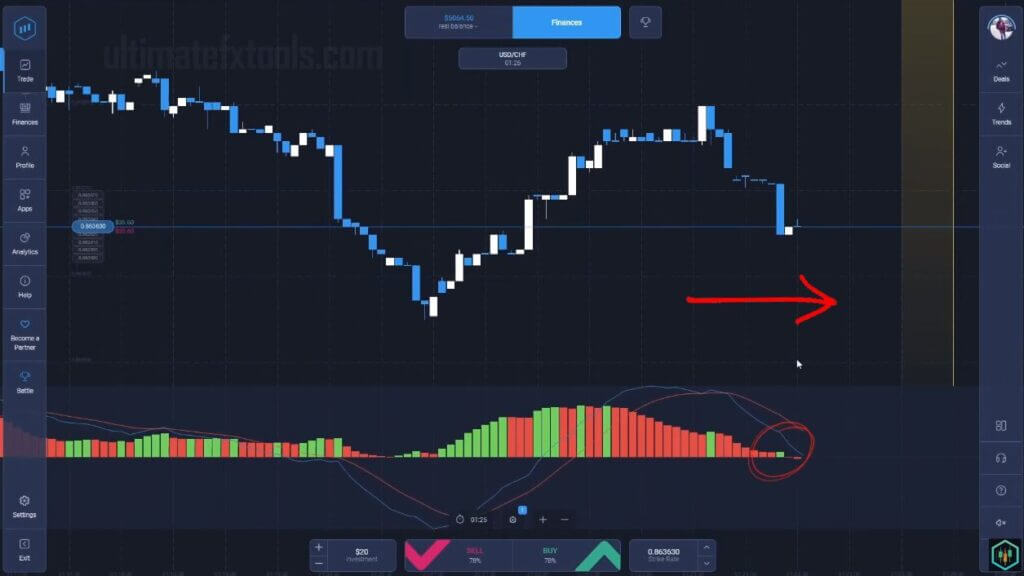
XProfit watches for short-term momentum shifts and prints an arrow on the MetaTrader chart — up for a possible move higher, down for a possible move lower. Because Expert Option runs its own chart, you read the arrow in MetaTrader and time it against the Expert Option candle. The MACD sits underneath as a second opinion, and the whole value of the filter is the trades it talks you out of.
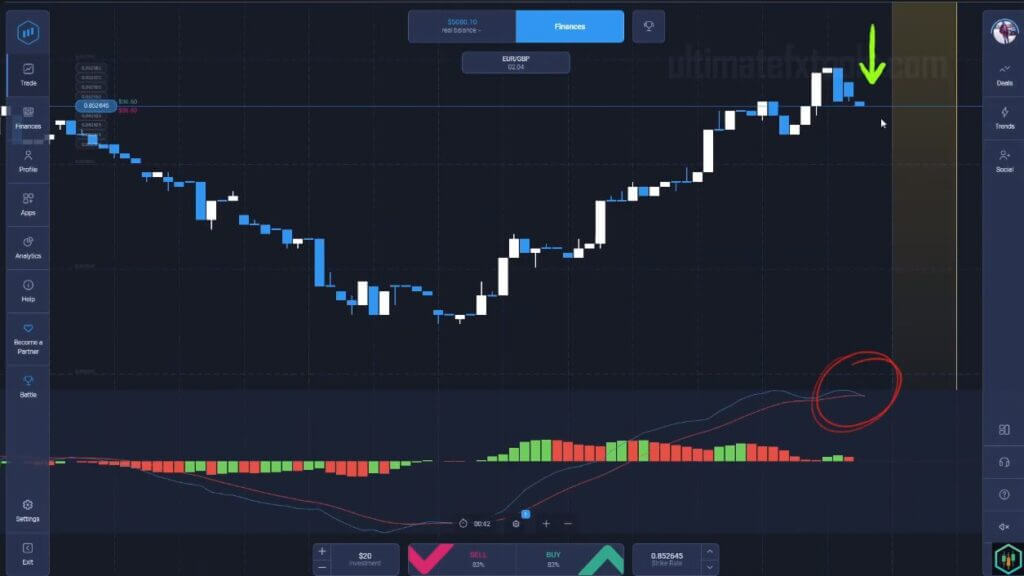
When the arrow and the MACD agree, the setup is clean. When an up arrow prints but the MACD histogram is still falling and the MACD line sits below its signal line, the two disagree and the alert is noise. Skip it. That skip feels like a missed opportunity in the moment, and it is the highest-value habit in this method — conflicting alerts are exactly where an undisciplined session unravels.
A Worked Read
Price has been sliding and finally puts in a low. A green candle forms off that low, XProfit prints an up arrow, and the MACD histogram has started to rise with the MACD line crossing above its signal. Three things point the same way, so the call side is defensible for a one-minute expiry. Defensible is not the same as correct — it can still lose, and that is a normal outcome, not evidence the method broke. Contrast that with a sell alert on EUR/GBP while the MACD still points up: same indicator, same platform, no agreement. You wait for confirmation rather than taking a trade because it appeared. Waiting is a position too.
How to Actually Improve Your Process
- Write your entry condition down before the session, in one sentence, and take only setups that match it. If you cannot state it in a sentence, you do not have a rule yet.
- Stake a small, fixed fraction of your balance on every trade. Never increase the stake to recover a loss — that is the fastest documented route to a blown balance in short-expiry trading.
- Cap the session. Decide in advance the maximum number of trades and a loss limit for the day. When either is hit, you are done, regardless of how the chart looks.
- Journal every trade: pair, time, what the arrow showed, what the MACD showed, whether you followed your rule, and the outcome. The rule-following column matters more than the outcome column.
- Let candles close before you read the alert. Reading a half-formed candle is guessing with extra steps.
- Practise on a demo account until the reads and the skips feel automatic. Demo is where you find out whether you actually follow your own rules.
After twenty or thirty journalled trades you will have something most traders never get: evidence about your own behaviour. Usually it shows the losses cluster in the trades you took outside your rule — a fixable problem. A search for a better arrow is not.
FAQ
Will this strategy improve my results on Expert Option?
It can improve the consistency of your decisions, which is the part you control. XProfit and MACD are decision-support tools that highlight setups worth considering — they do not predict outcomes, and losing trades are a normal part of binary options. Any claim of a fixed success rate should be treated as a red flag.
Do I need the indicator, or can I trade the MACD alone?
The MACD alone gives you direction but no timing trigger, so you end up guessing entries. XProfit supplies the trigger and the MACD confirms it; the pairing is what filters weak alerts. XProfit is included with every other tool on the site under a single $39 lifetime plan.
What timeframe and expiry should I use?
The one-minute chart with a one-minute expiry is the core setup for this reversal style. In choppy conditions, reading on the two-minute chart cuts down the number of weak alerts. Always match the expiry to the timeframe you read the signal on.
Related reading: the same tool applied to alerts in Expert Option alert signals, a companion walkthrough on enhancing Expert Option performance, a crypto variation in XProfit Bitcoin signals, and a MACD-led take in MACD with XProfit.
This content is for educational purposes only. Trading involves risk. Past results do not guarantee future outcomes. Always practice responsible money management and limit your daily trades to avoid large losses.