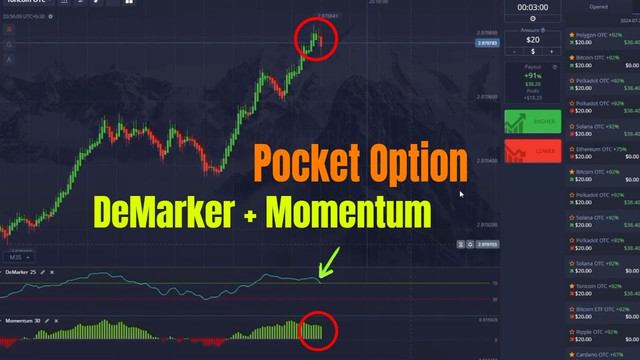
DeMarker + Momentum Heiken Ashi Strategy Overview
This strategy focuses on short-term crypto OTC trading using a two-indicator setup on Pocket Option. By combining the DeMarker and Momentum indicators with Heiken Ashi candles, traders can identify potential reversals and trend shifts more clearly on a 10-second timeframe.
Keep expectations realistic. Short-term OTC trading is fast and noisy, and no indicator pairing removes the risk of losing trades. Treat this setup as a structured way to filter entries, not a shortcut to fixed returns, and apply strict money management so a run of losing trades cannot damage your account.
What DeMarker and Momentum Actually Measure
The DeMarker compares recent highs and lows to gauge whether an asset is stretched into overbought or oversold territory, which can precede a reversal. The Momentum indicator measures the speed of price change, showing whether buying or selling pressure is building or fading.
Be honest about what this pairing gives you: both DeMarker and Momentum are momentum-type oscillators derived from price, so they read the same data in similar ways and tend to move together. That means they offer correlation rather than two independent confirmations. When they agree you get a cleaner-looking signal, but not the diversification you would get from pairing an oscillator with a volume or trend-structure tool.
Chart Setup
-
Set Chart Type to Heiken Ashi:
- Switch your chart to Heiken Ashi candles using a 10-second timeframe to capture more precise market movements.
-
Add the DeMarker Indicator:
- Configure the DeMarker indicator with a period of 25 to help identify potential reversals and overbought or oversold conditions.
-
Add the Momentum Indicator:
- Set the Momentum indicator to a period of 30 to gauge the speed and magnitude of price changes, signaling the strength of a trend.
Tradable Assets
This setup is applied to crypto OTC pairs on Pocket Option. Remember that OTC crypto prices are synthetic and platform-generated rather than a live exchange feed, so they can move in ways a real market would not. That volatility creates frequent signals but also more false ones, so stick to a small, familiar set of assets and learn how each behaves.
How to Read the Signals
Signal for a Lower Trade (PUT)
- The DeMarker indicator reaches the highest resistance level — this creates a solid reversal pattern at the top.
- After peaking, DeMarker drops back toward the 70 resistance level.
- Simultaneously, the Momentum indicator shifts its trend downward (green bar turning to red bar).
- When both conditions align, consider trading for price to go lower.
Signal for a Continued Downtrend (PUT)
- The Momentum bar transitions from green to red, indicating high tendency for the trend to move lower.
- The DeMarker indicator is positioned near the middle of its range, suggesting the downtrend may continue from that point.
Trade Execution
Set your trade duration to 3 minutes when dealing with over-the-counter (OTC) assets. OTC assets are not controlled by the usual forex system, so it is essential to closely follow specific patterns — every asset exhibits its own unique behavior and characteristics in the market.
Combining these indicators can make your decisions more disciplined, but the signals are still judgment calls, not certainties. To compare other fast-timeframe approaches, see the 10-second Pocket Option setup or the Zigzag and SuperTrend reversal method.
Watch the Full Strategy Walkthrough
See the DeMarker + Momentum setup in action — live chart, indicator configuration, and real entries on Pocket Option OTC crypto assets.
Risk Management
Because both indicators are momentum-based and OTC pricing is synthetic, protecting your capital matters more than chasing entries:
- Risk only a small, fixed percentage of your balance per trade so no single loss is significant.
- Set a daily loss limit and a maximum number of trades, then stop for the day once either is reached.
- Do not use a martingale or any strategy that doubles stake size after a loss. On volatile OTC assets a short losing streak can drain an account quickly, and martingale turns that possibility into a real danger.
- Test the setup on a demo account until you understand how the signals behave before risking real money.
The full indicator pack and other Pocket Option strategy walkthroughs are available in one place for a one-time $39 lifetime payment.
Frequently Asked Questions
Does this strategy win every trade?
No. No strategy wins every trade, and this one is no exception. DeMarker and Momentum only help filter for a reasonable entry; losing trades are a normal, unavoidable part of using it. Anyone promising a setup that never loses is not being honest.
Why use two indicators that are so similar?
DeMarker and Momentum are both momentum-type oscillators, so they largely confirm each other rather than adding independent information. The benefit is a cleaner, less ambiguous signal when they agree; the drawback is that agreement can be a false one when price whipsaws. Some traders add a trend or price-structure filter to reduce that overlap.
Is the 10-second timeframe suitable for beginners?
Very short timeframes are demanding. Signals appear and expire quickly, and OTC volatility makes them harder to read, so new traders often do better practicing on longer timeframes first.
This content is for educational purposes only and is not financial advice. Trading involves substantial risk; you can lose some or all of your capital. No result is guaranteed and past performance does not indicate future results. Trade only what you can afford to lose.


